Short answer
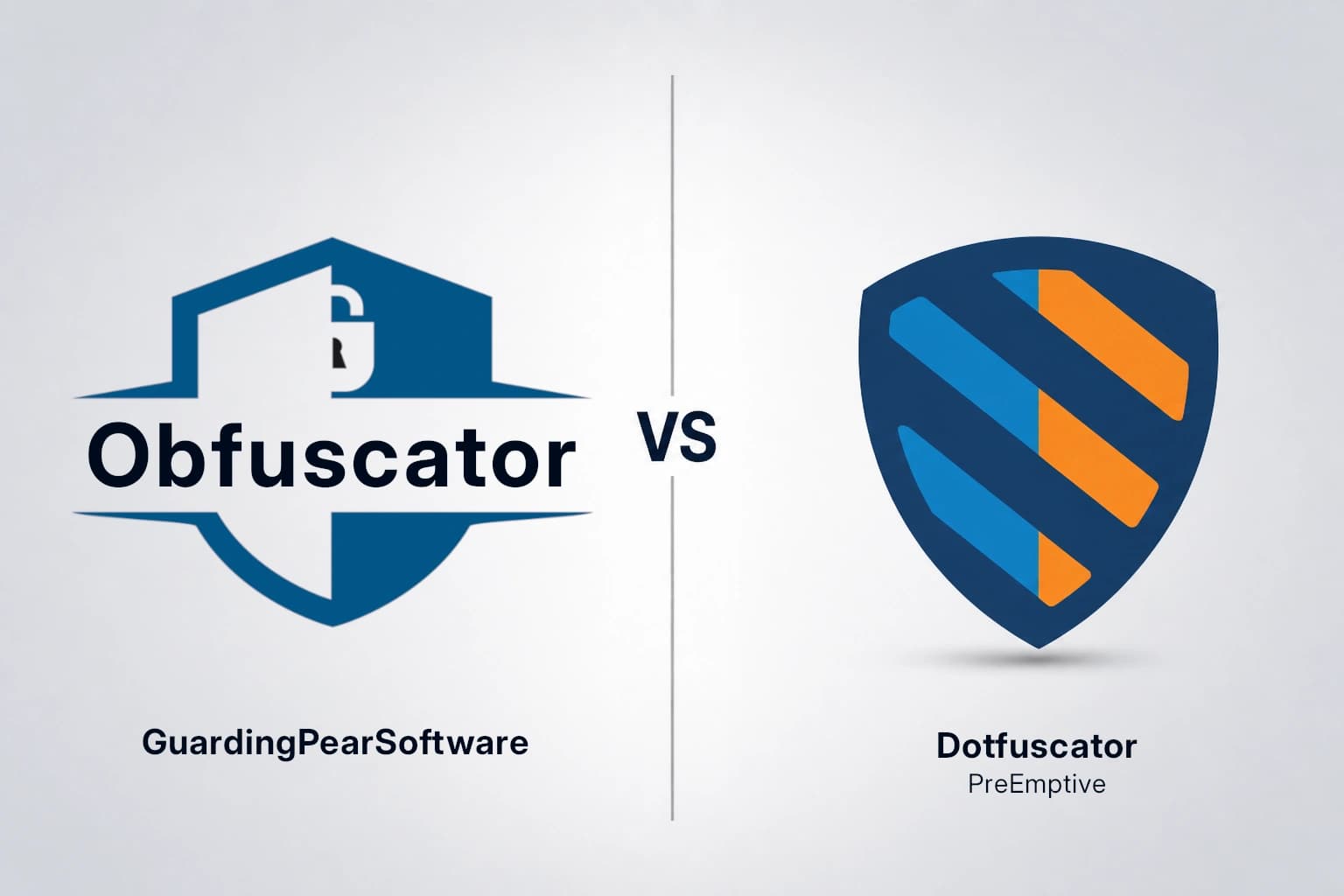
GuardingPearSoftware Obfuscator Pro costs $79.99 (one-time purchase). It includes symbol renaming, string obfuscation, fake code injection, method control flow, and anti-tamper checks. It runs directly inside your Unity build pipeline and patches your game assets when it renamesMonoBehaviour classes and other serialized types.
Dotfuscator Professional is a .NET protector with renaming (including Overload Induction), control flow, string encryption, tamper and debug detection, and RASP-style runtime checks. Community Edition is free with Visual Studio. It is meant for personal and non-commercial use, and it is too limited for a shipped game. Professional pricing is quote-only. Public developer reports sit around $2,400 to $4,250+ per year.
In simple words:
- Choose GuardingPearSoftware Obfuscator if you ship a Unity game and want an integrated build-time tool.
- Choose Dotfuscator if you already live in an enterprise .NET stack and procurement wants PreEmptive on the vendor list.
Quick comparison
| Topic | GuardingPearSoftware Obfuscator | Dotfuscator Professional |
|---|---|---|
| Vendor | GuardingPearSoftware | PreEmptive |
| Based in | Germany | United States |
| Main focus | Unity games and apps | Enterprise .NET apps |
| Price | $79.99 one-time (Free tier available) | Quote, often thousands per year |
| Free tier | Yes | Community, personal / non-commercial |
| Workflow | Inside Unity | Visual Studio, MSBuild, CI |
| MonoBehaviour renaming | Yes | No |
| String protection | Yes | Yes (Pro) |
| Control flow | Yes | Yes |
| Watermarks | Yes | No |
| Code virtualization | No | No |
| Mapping files | Yes | Yes |
| Best fit | From Indie to Enterprise Studio | Large .NET orgs |
What GuardingPearSoftware Obfuscator does
GuardingPearSoftware Obfuscator is a Unity cybersecurity asset. After you enable it, protection runs when you press Build. You do not export a DLL, open a second Windows GUI, then copy files back. The same hooks fire for a customBuildPipeline.BuildPlayer script and for cloud builders that run a normal Unity player build.
The package can rename namespaces, classes, methods, fields, properties, and events. And also rename the Unity types that most generic tools skip: MonoBehaviour, ScriptableObject, and Playable classes. After the rename pass, it updates scenes, prefabs, and other assets that still store those names.
Unity stores a lot of meaning as text. A button in the Inspector may keep the method name it should call. An animation event may keep a string. A serialized field on a component keeps its field name. Addressable bundles can keep script references too. Obfuscator has compatibility settings for those cases: Inspector values, UnityEvents, animation events, reflection and coroutines, UI Toolkit, and Addressables (JSON and binary catalogs, custom local or remote paths, and Addressable Shield on Unity 6 and newer).
It also hides strings, adds random fake code, and can suppress simple ILDasm inspection. Mono builds can get control flow and assembly signing. Standalone builds can get integrity checks. Mapping files stay available so crash logs are still readable after release. A Free tier exists if you want to test the pipeline first. MonoBehaviour and namespace renaming are Obfuscator Pro features.
The tool stays local. You do not send the game to a cloud protector. Because it runs inside Unity and Tuanjie, it works on any platform where those editors run, including Windows, macOS, and Linux build machines.
What Dotfuscator does
Dotfuscator has been the "Visual Studio obfuscator" for a long time. Community Edition: basic renaming, limited control flow, Shelf Life after registration. Library mode often leaves public members readable. The license is not meant for commercial shipping. Treat Professional as the real product if you sell the game. Professional Edition adds the features people actually want:- Stronger renaming, including Overload Induction
- String encryption
- Control flow
- Tamper response
- Debugger checks
- Runtime application self-protection
- Shelf Life expiry-style checks
The biggest difference
Dotfuscator sells depth for enterprise apps. GuardingPearSoftware Obfuscator sells Unity awareness for a game price. If your product is a bank desktop client, Dotfuscator's process and support model can make sense. If your product is a Unity mobile or PC game, paying thousands per year and then excluding most Unity types is a poor fit. A renamedPlayerHealth on a prefab that still says PlayerHealth in the scene is still easy to find. Unity tools that patch assets attack that problem. Dotfuscator has no such pass.
If you run it on a Unity assembly, it can rename your MonoBehaviour classes in the DLL. It cannot update your binary scene files, prefab assets, or Addressables bundles. When you launch the game, Unity reports missing script errors and your game objects break.
To avoid that, you must exclude every MonoBehaviour, ScriptableObject, serialized field, and UnityEvent callback. That leaves your most important game logic exposed with plain names.
Why Unity-aware renaming matters
Unity does not only compile C#. It also saves type names and member names inside assets. That is how the Inspector, scenes, and prefabs keep working after you close the Editor.If a generic protector renamespublic class PlayerHealth : MonoBehaviour { [SerializeField] private int maxHealth = 100; public void TakeDamage(int amount) { maxHealth -= amount; } }
PlayerHealth or maxHealth, the prefab can lose the script or reset the value. If it leaves those names alone so the prefab stays valid, attackers still search for PlayerHealth and find the logic.
GuardingPearSoftware Obfuscator is built for that tradeoff. It can rename the class and the serialized field, then update the related assets so the GameObject still points at the new names. Dotfuscator has no such Unity pass. Its safe default is to skip the names Unity stores as data.
Which one should you pick?
Pick GuardingPearSoftware Obfuscator Pro if you want:- A Unity build hook
- Asset-safe type renaming
- A one-time indie price
- No sales call to see the cost
- Mapping files for crash reports
- A known enterprise vendor
- RASP and compliance-oriented runtime checks
- Mapping and support contracts at company scale
- Protection for non-Unity .NET software