Can Unity games be hacked? What developers need to know.

Unity games can be hacked. Learn why, what attackers want, and how to protect your game without chasing perfect security.
By Tim UhlottFounder|Last updated: July 2, 2026|8 minutes read
cybersecuritygame developmentunity
Can Unity games be hacked? What developers need to know.
As a Unity game developer, you pour countless hours into creating your project. You write code, design levels, and perfect mechanics. But at some point, a terrifying question crosses your mind: "Can my game be hacked?" You might wonder if there is a way to make your game completely bulletproof. The reality of development is complex, and understanding how hackers approach Unity games is the first step in protecting your hard work.

Short answer: Yes, they can be hacked

Any game can be hacked, and that is normal. This is not a flaw specific to your code. It is a normal part of software development. Because games run on a player's computer or phone, the player ultimately controls the hardware. If someone has physical access to a device running your game, they can manipulate its memory or files. Knowing this is not a reason to panic. Instead, it is a reason to shift your perspective from making a game unhackable to making it difficult to hack.

Why Unity games are an easy target

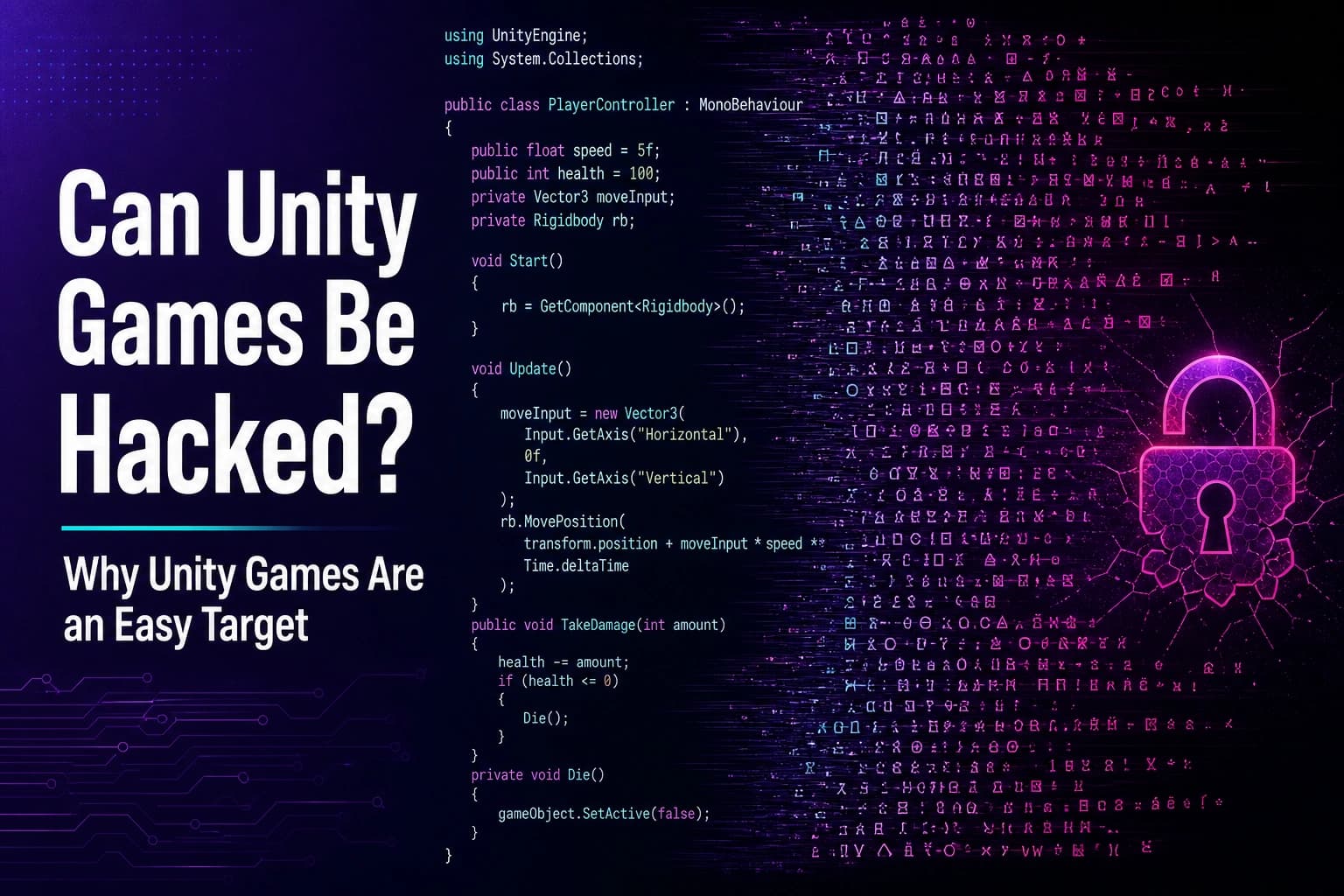
Unity is an incredibly popular game engine, meaning many people know how it works. By default, Unity compiles its standard Mono backend code into a format called Intermediate Language. This format is very easy to read if someone uses a tool called a decompiler. A decompiler can turn your game files back into readable C# code almost exactly as you wrote it. Even if you switch to Unity's IL2CPP backend, which turns your code into C++ and makes it harder to read, hackers still have powerful tools. There are programs specifically designed to map out IL2CPP games. Because Unity is so widely used, hackers share these tools and methods openly. This widespread knowledge makes it a prime target for people looking to modify games.

"Unhackable" vs "Not Worth Hacking"

You cannot build an "unhackable" game. However, you can build a game that is simply not worth the effort to hack. Hackers invest their time based on the reward they expect. If a game is very hard to break into and offers little reward, most hackers will give up. This concept is known as economic protection. Your goal is to make the cost of hacking your game higher than the value of the reward. If it takes a hacker weeks of frustrating work just to get an extra life in your game, they will likely move on to an easier target. You do not need perfect security. You just need enough security to make the process boring and frustrating.

What attackers actually do

When we say someone is "hacking" a game, we could mean several different things. Not all attackers share the same goals. Some people just want to cheat to feel powerful or beat a difficult level. Others want to crack the game to play it for free without buying a license. Then there are those who want to rip your assets. They use tools to extract your 3D models, textures, and music for their own projects. Finally, some attackers spoof data to pretend they achieved high scores on leaderboards. Understanding what attackers want helps you decide what parts of your game need the most protection.

Single-player vs multiplayer: Different threat models

The type of game you are making completely changes your security needs. In a single-player offline game, a cheating player only ruins their own experience. If someone gives themselves infinite gold in a single-player RPG, it does not harm anyone else. You might want to stop piracy or asset ripping, but gameplay cheats are a low priority. Multiplayer games are a completely different story. If one player uses an aimbot or a wallhack, they ruin the fun for everyone else. This can destroy your player base very quickly. For multiplayer games, you must design your game so the server controls all important decisions. Never trust the client device to tell the truth.

"My game is too small, will anyone care?"

Many indie developers think their game is too small or unknown to attract hackers. This is a dangerous assumption. You do not need to be a massive studio to get targeted. There are automated tools and communities of hobbyist hackers who look for small, unprotected games just for practice. Even a very small game can end up on a piracy website or have its leaderboard flooded with fake high scores within hours of release.

When hacking starts to hurt

Hacking becomes a real problem when it starts hurting your business. If your game relies on selling in-app purchases, hackers who give themselves free currency are directly stealing your revenue. In multiplayer games, a cheating problem leads to bad reviews. Bad reviews lead to fewer sales and a dying community. If hackers flood your online servers with fake requests, you might also end up paying massive server hosting bills. This is when hacking changes from a minor annoyance into a threat to your studio's survival.

What "good enough" security looks like

For most indie developers, "good enough" security means taking basic precautions. You should not leave your raw code completely open for anyone to read. You can use obfuscation tools to scramble your code, making it very hard for a human to understand even if they decompile it. Additionally, integrating anti-cheat systems can significantly raise the barrier to entry for common cheats. While we will not name specific products here, adding these layers of protection is a smart move. They will not stop the world's most dedicated hackers, but they will stop the vast majority of casual cheaters.

What you cannot realistically prevent

It is important to accept what you cannot control. You cannot stop someone from reading the memory of their own computer. You cannot fully stop screen reading software that uses artificial intelligence to aim for a player. Because the game runs on their device, dedicated attackers will always find a way to see what the game is doing. Focus on protecting the things you can control, like your server architecture and making your game files harder to read.

A practical mindset: Raise cost, don't chase perfection

The best approach to Unity game security is a practical one. Do not waste months of development time trying to build an impenetrable fortress. You will never succeed, and you will delay your game's release. Instead, focus on raising the cost of an attack. Use obfuscation, secure your server, and design your multiplayer games to not trust the client. Your goal is simply to make the hacker's job annoying. By doing this, you protect your revenue and your players' experience without losing your sanity.

Share this article

Frequently asked questions

Newsletter

Stay in the Loop.

Subscribe to our newsletter to receive the latest news, updates, and special offers directly in your inbox. Don't miss out!