Build, buy, or generate
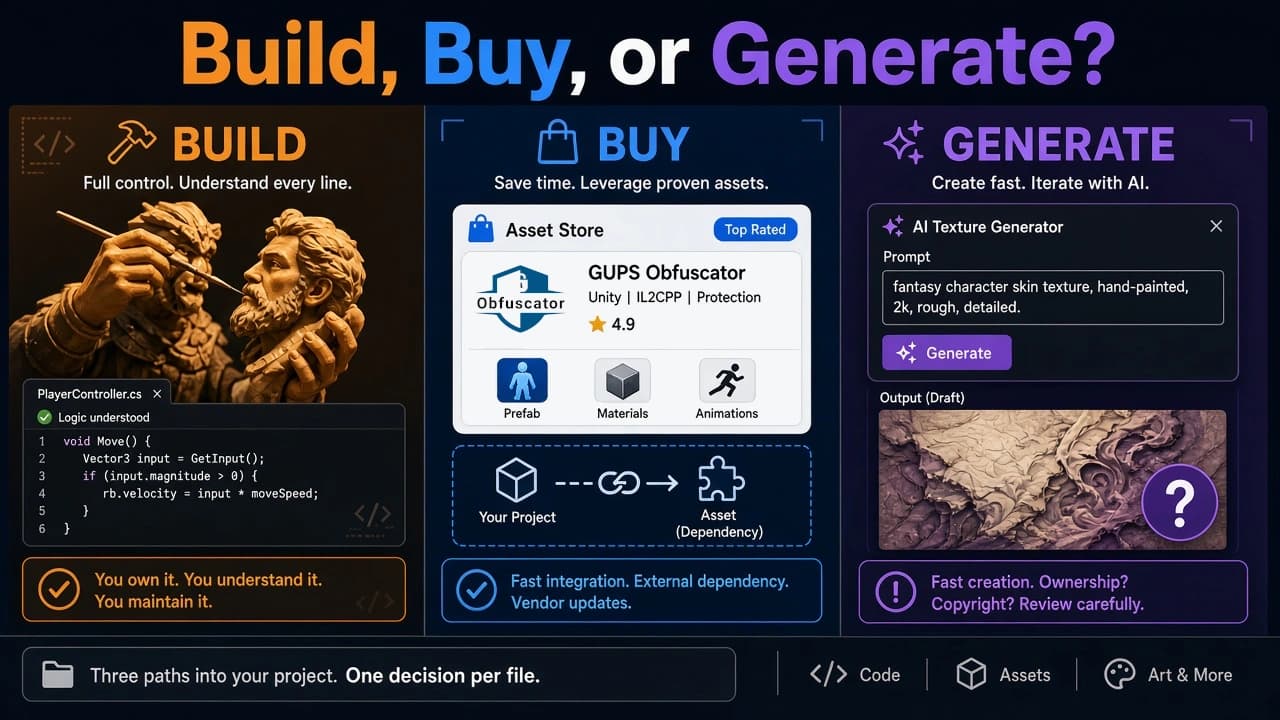
Most still treat this as two boxes, the build or buy box. In practice you have three, and they mix. Build means you or your team make the thing. Pixel art. A custom editor window. A combat loop. You own the files. You also own the bugs. Buy means you pay for something that already exists. The Unity Asset Store, the Godot Asset Library, itch.io, Kenney-style packs, a contractor, or a SaaS backend. You get a license, not always ownership. Someone else already paid the first year of mistakes. Generate means an AI model produces a draft. Art, music, a script, a tool. You still chose the prompt. You did not necessarily author the result in the legal sense, and you may not understand it in the technical sense. There is a fourth path people forget: hire or partner. A composer, an animator, a security engineer. That is still "buy," just of time and taste instead of a zip file. Write the deal down and pay someone does not always mean you own what they made. I already wrote about that in protecting your game IP while working with other teams. AI sits across all three. You can build a small tool with a coding agent. You can buy a plugin that was itself written with one. You can generate a placeholder texture and later replace it. The decision is still about who owns the file, who can fix it, and whether a player will care.Takeaway: Build, buy, and generate are three ways to get a file into the project. The useful question is not "can AI do it." It is "who owns it, who maintains it, and will a player care."
What you gain, and what you take on
But let us be real. None of these options is some kind of one-size-fits-all solution. They all come with tradeoffs.If you build
You have the thing in your hands. You are not waiting on a vendor patch. You can change it when the game changes. You understand it, or you will by the time it ships. If you wrote it, you usually own it. That matters for a remaster, a port, or a sequel. But you also need the skills to do it. If you do not have it, "build" is a training course with your launch date as the exam. You spend time that is not on the game players pay for. You maintain it. A custom inventory is not done when the first pickup works. It is done when it still works after the third combat rewrite, the console save API, and the player who drops a full stack during a cutscene. AI does not remove that last part. It can write the first version faster. But it cannot sit with you when the edge case appears in a live build.If you buy
You get speed. Someone already solved the boring failures. There are docs, reviews, and other games that shipped with it. The price is visible. A small team can look bigger than it is. You also depend on someone else. The store page can go dark. The author can raise the price, drop support for the engine you use, or vanish. The asset is not exclusive. Other games can use the same trees, the same RPG kit, the same synth loop. The license may block a use you assumed was fine. The code is often a black box until it breaks, and then it is your box. Bought things still take learning. A dialogue plugin you do not understand will surprise you in production. That is the expensive kind of surprise.If you generate
You get the fastest prototype. You can try ten looks before lunch. And placeholder assets get cheaper. But you often do not get copyright in the raw output. A paid Midjourney or Suno plan can grant commercial use. That is not the same as owning the image or the song. Training-data lawsuits are still moving. Players can see the look and dislike it. Steam will ask you to disclose player-facing AI content. Style drifts. Characters do not stay consistent. You also skip the craft, which is fine for a jam and costly if the game becomes your identity.| Path | You gain | You take on |
|---|---|---|
| Build | Control, fit, understanding, usually ownership | Time, skill, forever-maintenance, your bugs |
| Buy | Speed and a visible price. Work other games already shipped. | Dependency, sameness, license limits, a black box |
| Generate | Fast drafts, cheap exploration | Weak ownership, legal fog, player taste, inconsistency |
Takeaway: Building buys control. Buying buys time. Generating buys a draft. None of them is free. The bill just arrives in a different month.
A simple test before you start
Ask these before you open the Asset Store or a chat window.- Will players notice this? A unique character face, yes. A crate texture in a prototype, no.
- Is this why someone buys the game? Combat feel, world tone, the joke in the writing. Those are usually yours. A crash reporter is not.
- Do you understand it well enough to fix it on a Sunday? If the answer is no, do not generate the production version. Buy something with support, or learn it first.
- Will you still need this in two years? A jam HUD can be disposable. A save format cannot.
- Can you replace it if the vendor dies? If the answer is no, you just hired a landlord.
- Does the license let you ship, sell, port, and later remaster? Read it. "I clicked agree" is not a plan.
Takeaway: Spend authorship on what players pay for. Spend money on what players never see. Spend AI on what you are willing to delete.
Art, models, textures, and music
This is the category AI changed the most, and the one players argue about the most.What is possible
You can make, buy, or generate almost every visible and audible piece: textures, sprites, 3D models, animations, UI kits, VFX, voice, and music. A solo developer in 2026 can fill a grey box in a weekend. That used to take a month or a friend who "likes drawing." That is the good news. The rest is about whether you should ship it.Bought art is legal, and it is shared
Unity says (opens in a new tab) most Asset Store packs, including free ones, can go into a commercial game on a royalty-free basis. You cannot resell the pack as a pack. You also do not get an exclusive look. The standard Asset Store EULA (opens in a new tab) is a non-exclusive license. The same knight, the same forest, the same UI skin can appear in someone else's trailer next month. Godot's library, itch.io packs, and CC0 sets like Kenney (opens in a new tab) follow the same idea with different paperwork. Always open the license file. "Restricted" Unity assets are personal use only. Some music packs ban streaming or force credit. Some voice packs ban YouTube let's plays, which is a nasty surprise after launch. Bought art is still a strong choice for:- prototypes and vertical slices
- background props nobody studies
- genres where a shared kit is the aesthetic (low-poly strategy, asset-flip-adjacent mobile)
- teams with no artist and a deadline
Generated art is fast, and ownership is thin
In the United States, work made entirely by a machine is not copyrightable. The U.S. Copyright Office (opens in a new tab) said that again in its January 2025 Part 2 report: prompts alone do not give you enough control to be the author. The D.C. Circuit agreed in Thaler v. Perlmutter that human authorship is required. Zarya of the Dawn kept copyright in the human writing and in the way images were arranged. It lost copyright in the individual Midjourney pictures. So you can often use a generated texture under a tool's terms. You may not be able to stop someone else from using a near copy. Midjourney's paid plans grant commercial use. They do not hand you a copyright registration. Suno's paid plans do the same for music, and Suno does not promise the output is free of other people's songs. Record labels have already sued AI music companies over training data. A click-through that says "commercial use" is permission from the tool. It is not a shield if a rights holder later says the output is too close to a real song. If you care about owning the look, a human has to change the work in a real way: redraw, sculpt, compose, arrange. Prompting harder is not that.Players can see it, and some of them will hate it
Legal clearance is not the same as a Steam review. Valve's Content Survey (opens in a new tab) asks about generative AI that ships with the game and is consumed by players. Art, sound, narrative, localization, store art. Coding assistants and other behind-the-scenes tools are not the point. Pre-generated content is reviewed like any other content. Live-generated content also needs a written note about guardrails, so the model does not invent illegal material while someone is playing. Players still vote with reviews. Vapor World launched into Early Access with AI cutscenes that could not keep a character consistent. PC Gamer (opens in a new tab) noted that the most helpful review talked about the first cutscene, not the combat. The studio later restored the in-engine scenes and pulled the generated ones. That pattern has repeated: a shortcut in a place players look first, then a patch, then a promise. There is also the opposite failure. Games have been review-bombed on a guess that they used AI. Disclosure does not make everyone happy. Hiding it is worse. Use generated art where it is honest:- grey boxes and pitch decks
- idea sheets you will redraw
- internal mocap-style blocking
- a jam you will not sell
Music is a special trap
A loop from a store is easy to license and easy to recognize. A custom track costs money and is yours. A generated track is cheap, hard to own, and easy to hear as "the AI playlist." If music is part of why people remember the game, hire a person or write it. If it is menu filler for a prototype, a licensed pack is enough.Takeaway: Generated and store art are excellent prototypes. They are a weak identity. If players will stare at it, either make it or hire someone who can.
Software tools you use to make the game
Now the stuff players never see: importers, build scripts, editor windows, atlas packers, localization exporters, cybersecurity tools, CI.Simple tools are a good build
A tool that does one job, on your machine, with no live server, is often cheaper to build than to buy. Especially now. Examples that age well:- a button that rebakes addressables and names the folder correctly
- a CSV-to-ScriptableObject importer
- a scene validator that fails the build if a collider is missing
- a localization dump
- a screenshot tool for marketing
Complex tools are a good buy (or a good "buy and extend")
Do not build a second engine unless the engine is the product. Do not build a second Photoshop. Do not build a full analytics stack so you can say you own the events. Buy or adopt things that are other companies' whole job:- audio middleware (FMOD, Wwise) if your mix is serious
- crash and performance telemetry
- store SDKs, achievements, cloud saves
- version control hosting, CI, disk backup
- a battle-tested cybersecurity tool if you do not want to invent one
Maintenance is the real price of building a tool
A tool is cheap on the day it works. It gets expensive when:- the engine updates and your reflection breaks
- a teammate is afraid to touch it
- you are the only person who knows the flag that skips the bake
- it grows a UI, then a settings file, then a Discord thread
Takeaway: Build the small, local, boring tools. Buy the large, shared, moving-target tools. If AI writes the small one, you still have to be able to read it.
Gameplay systems: you should know what happens
One of the most important chapters, that can save your project! Combat, movement, inventory, quests, saves, netcode, economy. These are not "assets." They are the game. If something unexpected happens here, players do not blame the plugin author, they will blame you.Bought systems hide decisions
An RPG kit can drop you a working party, a loot table, and a level-up screen in a day. It also drops you someone else's ideas about stacking, weight, save keys, and what happens when two status effects tick on the same frame. That is fine while you learn. It is dangerous when you ship. You will want a rule the kit does not have and you will patch around it. Six months later nobody can explain why gold is a float. If you buy a gameplay system:- read the source, or do not buy it
- write down the rules you are accepting
- keep your genre-defining twist outside the black box
- have an exit plan (export the data, rewrite the runtime)
.cs files.
Built systems need a scope knife
The failure mode of building is not "it is impossible." It is "it is possible forever." A custom inventory can eat a quarter. A custom dialogue graph can eat a year. A custom engine can eat the studio. Build the system if:- it is the reason the game exists (the deck, the factory, the conversation)
- you already know the rules in your head
- you can ship a dumb version first and grow it
The hybrid that usually works
Own the rules and borrow the plumbing. You write what an item is in your game, how damage is decided, how a lie in dialogue changes a flag. You borrow UI grids, input helpers, tween libraries, navmesh addons, and save-file serializers after you understand what they store.Takeaway: In game systems, surprise is a bug. Buy plumbing. Build (or deeply learn) anything that decides what the player can do.
Cybersecurity tools
Yes, you can build these. Plenty of teams write their own server checks, their own save signing, their own "is this speed possible" test. You should still know what attackers actually do. A tool you do not understand is decoration.What is possible
A small studio can, without a security department:- keep the repo private and turn on 2FA
- stop trusting the client for gold, inventory, and match results
- rate-limit APIs
- hide obvious strings and names so casual dumpers bounce
- encrypt or pack shipped art so the raw folder is not sitting in
StreamingAssets
Buying a tool does not buy understanding
Tools only help if you use them correctly. If you have good habits, basic tools can do a lot. But if your habits are weak, even the best tool will not protect you. For example, antivirus is not enough if you use the same password everywhere. In games, using an obfuscator does not help if your code still allows obvious cheats likeAddGold(999999).
Buying the right tool is important. Most .NET obfuscators do not fully protect Unity projects, they change code names but do not understand assets or prefabs. It looks like it worked, but anyone can still find your important data. Buy tools that actually understand and cover all parts of your engine. Then, test for yourself by searching your build to see what is really hidden.
The same principle goes for anti-cheat, encryption, and anti-tamper tools. Don't just believe the sales pitch—check what they actually protect. Remember: a determined attacker can still dig into your client. Real protection, like authority over game logic and validation, should always be on the server.
Buying good, specialized tools saves you time and helps you avoid common mistakes—but only if you know what they really do. For more detail on security layers, see cybersecurity for game developers.
When to build the check yourself
Build the rules that are unique to your game. Only your team understands that a dash can't go 80 meters, or a chest can't open twice, or a trade can't reward both sides. No purchased anti-cheat will ever know those details. Buy the generic, difficult parts: encryption you can trust, a Unity-friendly obfuscator if needed, DDoS protection, secure data storage you didn't invent yourself. Generate draft validators or checks with AI if you like, but remember. People might notice, and they might not like it.Takeaway: Build the parts only your game knows. Buy the generic, difficult parts you should not invent. Generate a draft if you want, then make sure you still understand it.
A map by category
Use this as a starting point, not a law.| Thing | Prototype | Ship | Why |
|---|---|---|---|
| Background props, crate textures | Buy or generate | Buy, or replace the ones in frame | Players skim these |
| Hero art, key characters, logo | Sketch or generate | Build or hire | This is the face |
| Music and voice | Temp pack or generate | License or hire | Ownership and memory |
| Tiny editor utilities | Build (AI draft is fine) | Keep them small | Low maintenance if they stay tiny |
| Engine, DCC apps, CI, analytics | Buy | Buy | Not your product |
| Dialogue / narrative runtime | Borrow Ink or Yarn | Borrow, write your content | Plumbing vs writing |
| Combat, movement, economy rules | Grey box, even generated | Build or fully learn | Players feel surprise here |
| Inventory / quest / save kits | Buy to learn | Own the data and the rules | Kits hide decisions |
| Backend (login, inventory service) | Buy or open source | Buy unless ops is a skill you have | On-call is the hidden price |
| Client hardening, obfuscation | Skip or cheap test | Buy Unity-aware tools, then verify | Easy to get half-right |
| Server authority and cheat rules | Stub | Build the rules yourself | Only you know valid play |
| Studio access, 2FA, contracts | Do it on day one | Keep doing it | Not a store pack |
How to decide this week
A practical order that does not require a strategy offsite. 1. Name the identity. Write five things a player would remember. Those five are build-or-hire. Everything else starts as buy or generate. 2. Time-box the prototype. Use store packs and generated drafts on purpose. Put them in a folder namedtemp. Do not polish a generated hero for a vertical slice you will throw away.
3. Read every license you will ship. Asset Store, itch, font, font again, music, voice, AI terms, engine EULA. If you cannot explain the license in one sentence, you do not have a license you understand.
4. Prefer source you can read. For gameplay plugins, closed DLLs are a last resort.
5. Prefer tools that die quietly. A 60-line bake script you can rewrite is better than a 15-module framework the author abandoned.
6. Do not generate the production path you cannot explain. AI for a first inventory is a lesson. AI for the live economy is how you get a dupe.
7. Revisit after the first playable. The right answer at grey box is often wrong at Early Access. Replacing a tree pack is cheap. Replacing a save format is not. Make the second kind of decision late, with more information, not early, with hope.
8. Write people down. If a contractor, a plugin author, or a "friend who helps with Steam" can block your next build, you need a written agreement. Because access is part of the buy.
None of this says "never use AI" or "never open the Asset Store." It says: use them where the cost of being wrong is small, and keep authorship where the cost of being wrong is the game.