Hoop Dynasty - The Continue button is the hardest part of a living sports simulation

How a decade of long-season testing, QA alerts, and a 100,000-line services layer shaped Hoop Dynasty: Rise of a Legend.
By Giulio CarusoGuest|Last updated: August 13, 2026|7 minutes read
community spotlightindie
Hoop Dynasty - The Continue button is the hardest part of a living sports simulation
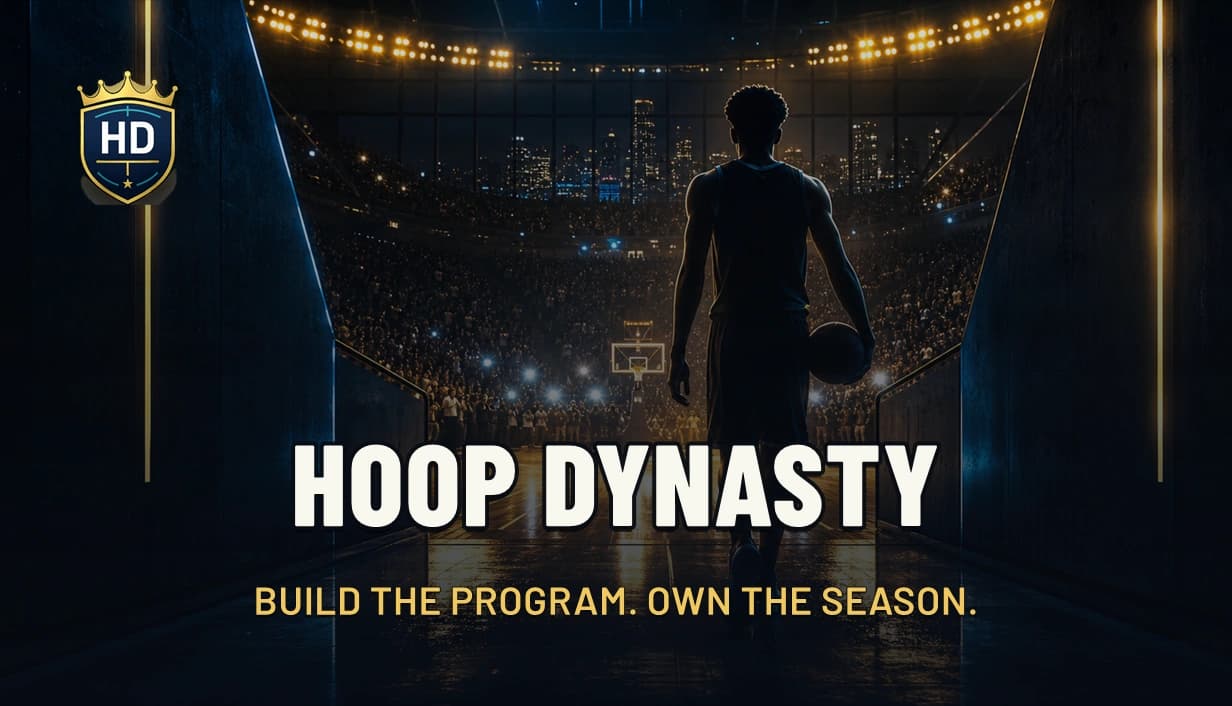
When I started building Hoop Dynasty: Rise of a Legend, the interface was rough and the project was still searching for its final identity. The real work was happening underneath. I am Giulio Caruso, the solo developer behind the game. Hoop Dynasty is a single-player basketball career simulator. You do not watch a legend from a distance. You build your own. Create a young prospect, choose your role, shape your skills and mentality, then live an entire basketball career in an original world that evolves season after season. You can begin in College, enter International basketball, or face the pressure of the Pro world from day one. Every path carries different opportunities, risks, and expectations. Performances, consistency, form, injuries, and decisions determine your minutes, development, and reputation. A prospect can become a star, or follow a path no one expected. That living world is the part that took years to make honest.

The work happened in long simulations

I spent years simulating careers through repeated, sometimes almost endless cycles. I wanted to understand what happened to rosters after several seasons, how injuries affected development, how contracts changed the balance between teams, and how a player's career could remain believable over time. Many of the most important corrections came from these long simulations. A roster could become unbalanced. An injury could have too much or too little impact. A player could develop in a way that looked mathematically valid but felt completely wrong from a basketball perspective. That forced me to create a QA system capable of generating alerts around the mathematical model behind the game. It had to identify unusual roster situations, unexpected progression, injury patterns, broken career paths, and inconsistencies that were almost impossible to see during a short manual test.

Pressing Continue starts a chain of events

The most difficult part, however, was creating the living world. In Hoop Dynasty, pressing Continue does not simply move the calendar forward. It activates a large chain of events and validations. Matches are processed, player conditions change, rosters evolve, injuries are evaluated, contracts and decisions move forward, national team selections can appear, rivalries develop, and the world records the consequences. Every new feature has to find a place inside that chain without breaking something that already works. The Services layer that powers this system has grown to roughly 100,000 lines of engine code. I do not see that number as a badge of honour. I see it as a reminder of how much interconnected logic a sports simulation can contain. Whenever I had a new idea, I could not simply add it in isolation. I had to understand where it belonged, what it affected, and how it would behave after several seasons. The goal was not just to make the feature work once. It had to remain coherent inside a world that keeps moving.

The bugs that only appear after many seasons

There were also plenty of absurd moments. I remember situations where a player was called up to the national team and then never returned to the club. Other bugs were less obvious but even more dangerous, because the simulation continued while quietly becoming inconsistent. That is why the QA system became such an important part of development. It allowed me to observe the world over long periods, catch problems earlier, and measure whether the mathematical model still produced believable outcomes. Hoop Dynasty is still not perfectly coherent. That is one of the main areas I am working on before the demo. The ambition is not to pretend that a complex simulation is flawless. The ambition is to make the remaining inconsistencies visible, understandable, and progressively easier to correct.

Ten years, nights, and Visual Studio

I have been working on this project for more than ten years. I develop it after my regular job and family time, often late at night, with little more than Visual Studio, a cigarette, and another season to investigate. The project has changed enormously since the first prototypes. The UX became more deliberate, the systems became deeper, and the world became much more ambitious. But the central question remained the same: Can this world continue to live when the player is not looking?

Where AI fits, and where it does not

That question is also where I use AI today. I write the code and design the systems myself, then use AI to challenge the implementation, search for weaknesses, and expose blind spots. I do not delegate the game's logic or its design identity to AI. Some promotional assets were also created with AI, but the final creative direction and selection remain mine. I still do not know exactly where Hoop Dynasty will take me. I do know that it now has an identity of its own. After so many years, that is what gives me the confidence to keep pushing it forward. Every season is another test. Every Continue button is another chance to find out whether the world is still alive.

Build an arena the world will remember

Hoop Dynasty needs places with an identity. Until 16 August 2026 at 23:59 CEST, the first HD Foundry community challenge is open: imagine the next arena in this universe and turn it into a proposal ready for editorial selection. Give it an original name, a fictional city or region, an architectural identity, an atmosphere the crowd would recognize with their eyes closed, and one ritual or detail that could become part of its legend. No real teams, leagues, brands, venues, or copied identities. Build something that could only belong to the Hoop Dynasty universe. Every entry goes through editorial and originality review. Selected ideas may be adapted for the game world and credited in the Community Credits. Submission does not guarantee inclusion. The strongest ideas are the ones that feel ready to live inside the game. Enter the arena challenge

Share this article

Frequently asked questions

Newsletter

Stay in the Loop.

Subscribe to our newsletter to receive the latest news, updates, and special offers directly in your inbox. Don't miss out!