The strange life and afterlife of a gamescom booth

A friendly guide for game developers on what gamescom does for wishlists, meetings, playtests, and your marketing budget.

By Tim UhlottFounder|Last updated: August 24, 2026|18 minutes read
marketinggamescomfair
The strange life and afterlife of a gamescom booth
There is a particular silence three feet behind a stranger who is playing your game. The hall is roaring. Someone in a foam dragon suit is shouting for a photograph. A trailer is detonating from a stand the size of a house. And still, for five minutes, the only thing that matters is this person's thumbs, and the tiny frown they make when they cannot find the button you thought was obvious. Every August, a small studio bets a frightening amount of money on that frown. A booth in Cologne. Flights. A hotel that has decided, for one week, that it is a luxury brand. Printing. A monitor. Five days in which nobody works on the game. Then someone asks the question that hangs over the whole trip: would that money have done more as a YouTube video or just paid ads? It's a difficult question, partly because there just aren't many firsthand accounts from studios that have exhibited at gamescom. There's plenty written about the event itself, but much less about what effect having a booth actually has on a game's success. That's the question we'll explore here, and try to answer. The gamescom 2026 runs August 26 to 30, with Opening Night Live on August 25 and more than 1,600 exhibitors expected. The figure is meant to impress you. It should. It also tells you almost nothing about what happens to one small game after a thousand people walk past it, smile, and vanish into the next hall. Yet two studios broke the usual silence: they shared their actual numbers, wishlist graphs and all. Here is what happened for them, and what their data means for everyone else facing the same decision.

The week Settlement Survival could not keep

PreMortem Games wrote up the 2022 show for Settlement Survival, and they included the part most studios treat like a family secret: the cost. Roughly $15,000. Three months of planning. Six days of standing for more than twelve hours, which is a polite way of saying that your feet will file a complaint. Here is what the Steam page did.
DayWishlists per day
A normal day before the showabout 450
August 24about 1,449
August 25 to 27about 800
August 28just above 600
September 1back to normal
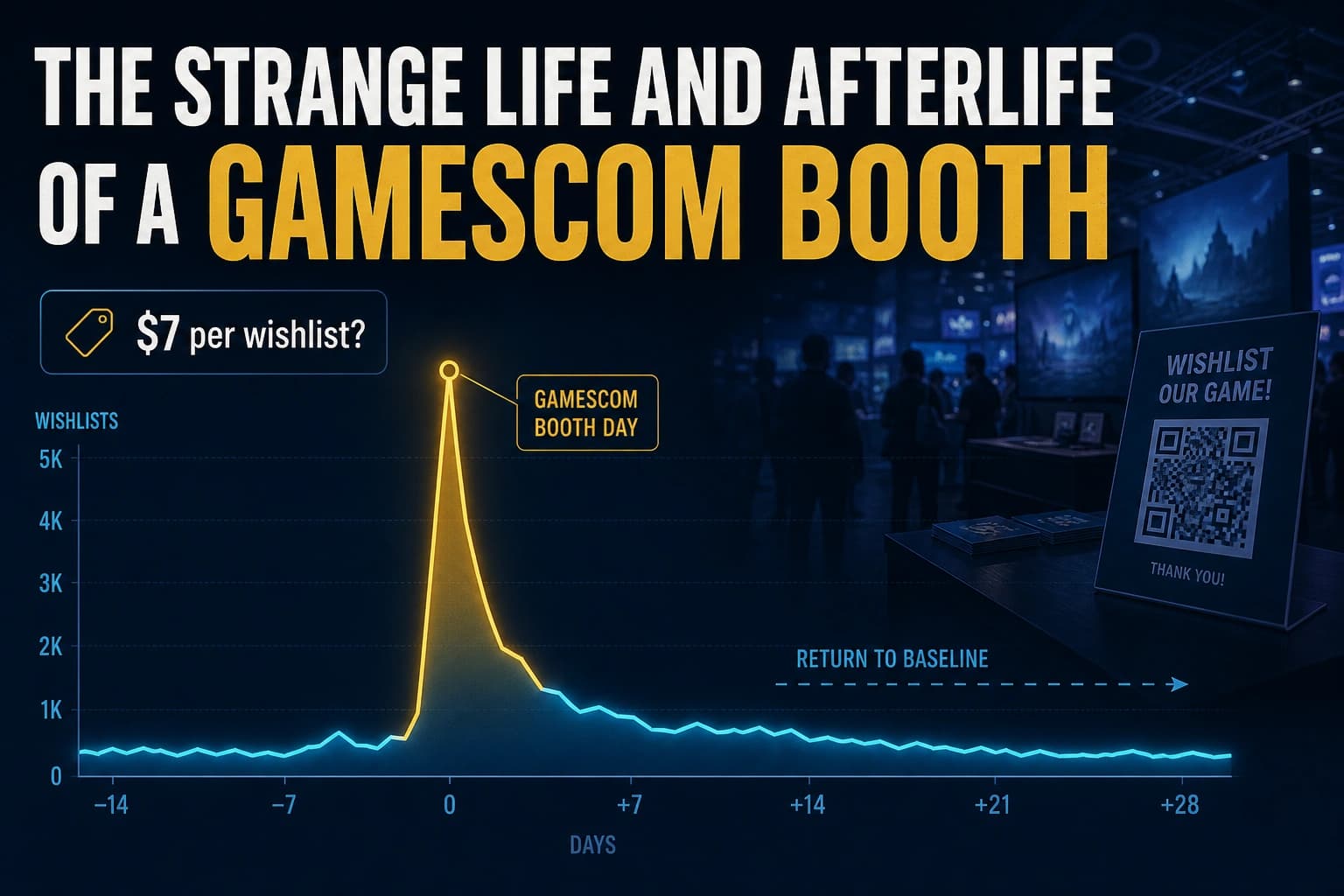
The show did not lift the game onto a new plateau. It gave the chart one wild day, a short afterglow, and then the old life came back, as if the halls had never existed. You can put a rough number on the part that was actually extra. Take each day above 450, the pace the game would have had anyway, and add up the surplus. The August 24 spike is worth about 1,000 extra wishlists. The three days near 800 add roughly 350 each. The fade adds a little more. That lands somewhere around 2,000 to 2,300 wishlists that would not have arrived without that week. Against $15,000, that is roughly $7 per extra wishlist. Not a catastrophe. Also not a miracle. And here is the wrinkle the studio was honest enough to mention: they landed an IGN announcement in the same stretch, and they could not unpick the booth from the article. So some of those wishlists were born in a browser, not directly in front of a demo. Then they shared a comparison that puts things in perspective. A single YouTuber’s organic video brought in over 4,000 wishlists in one day for another game in the same genre. That was one creator and one upload, with none of the expenses or spectacle of an expo booth.
Takeaway: Do not get demotivated by the numbers. Focus on the lasting change it makes beyond your usual baseline, not just on raw numbers during the event.

The week The Rabbit Haul learned where people actually came from

Caldera Interactive published a breakdown of gamescom 2024 for The Rabbit Haul, and their numbers answer a different, sneakier question. Not "how many wishlists," but "who sent those people?"
Metric (August 20 to 25, 2024)Result
New Steam wishlists1,293
Unique people who played the demo at the boothabout 733
Unique Steam page visits2,745
Share of those visits from the gamescom Steam Sale page42%
Visits from the booth QR codes and handoutsabout 466
Do the sums on the last two rows. The gamescom page on Steam sent roughly 1,150 visits. Everything the team physically pressed into a human hand sent about 466. Sit with that. The booth is the part you can photograph. It is the part your parents will understand. Hundreds of people held a controller, laughed, said the game was cute, and then walked into a hall the size of a small city and forgot the URL. Meanwhile a Steam page, silent and unstaffed, did more than twice the work. It gets stranger when you compare 733 players with 1,293 wishlists. Even if every single person who played went home and wishlisted, which they did not, that would still be only a bit more than half of the week's total. Most of the wishlists came from a place the team could not see. Because stores like Steam will tell you that a visit arrived, not whether it came from Discord, a trailer, or the QR taped to your booth. A store-visit tracker can give each store page its own short link, print a QR for the floor, and show which channel sent people. It will only do the part Caldera published: where people actually came from. The team also ran more than 700 playtests on the floor and put nearly 500 people through a scavenger hunt with partner studios. They planned the week as a playtest as much as a marketing push. That is why their write-up still sounds like a good week, even with modest wishlist numbers. They were not only hunting clicks. They were watching faces. Two caveats they were honest about. Their trip was largely subsidized, so their return is rosier than yours will be. And the show is a lottery dressed as a trade fair. Some studios in the Indie Arena Booth left with a few hundred wishlists. Studios whose trailers made it into a big showcase sometimes added thousands before lunch.
Takeaway: Get into the official gamescom Steam event and any showcase you can, even if it costs you a favor or a fee. That digital placement moved more people to the store page than the physical booth did. Also gaining feedback from playtesters could be worth the cost of the booth.

A city inside a city, and why that can fool you

Now the size, because it explains why a good booth week can still feel like shouting into weather.
YearVisitorsExhibitorsExhibition spaceSource
2009 (first Cologne show)245,000 (228,000 public)458about 120,000 m²GamesIndustry.biz
2019about 373,000n/an/aWelt / dpa
2022 (first physical show after COVID)265,000n/an/agamescom worldwide
2024335,000 from about 120 countries1,462 from 64 countriesabout 230,000 m²game association
2025357,000 from 128 countries1,568 from 72 countriesabout 233,000 m²Games Press
2026no official forecastmore than 1,600233,000 m², fully bookedWelt / dpa
357,000 people came in 2025. That is roughly Bonn, poured through 233,000 m² of halls, which is about 33 football pitches of carpet, light, and noise. It is still below the 373,000 of 2019, and that is deliberate. Organizers cut ticket numbers after 2019 because the crowding made people miserable. Here is the useful way to read that table. Your game is one of more than 1,600 exhibitors. The 2026 indie area alone holds more than 420 companies, up from 364. Divide hundreds of thousands of visitors by that many booths and the average share stops looking like a crowd. It looks like weather that happens to pass your window. Those visitors are also not only there for games. Between the halls there is esports, hardware, merchandise, concerts, and a Cosplay Village. Organizers describe an audience that also cares about films, music, sport, food, and fashion. Somebody who spent two hours in the merch hall and one hour queuing for a Cosplay contest has very little patience left for an unknown demo. Your game is competing with a festival, not just with other games. The online side is where the growth really lives. The 2024 program passed 310 million video views by Saturday evening. In 2025, organizers reported more than 630 million by Saturday and later counted about 1.1 billion video-on-demand views. Opening Night Live alone reached 72 million. A SPORTFIVE report adds that 63% of visitors arrive with friends, and that most of the younger ones make their own content. It feels backwards, but that's the story from The Rabbit Haul: gamescom is no longer mainly a gathering, it's a broadcast, and the convention halls are just the stage set.
Takeaway: Your booth is one of 1,600 or more. If your plan does not include the digital half of gamescom, you are buying the smallest part of the event.

What the same money buys if you stay home

Before you book, price the alternatives in the same units. This is the sheet that keeps the romance from writing the cheque.
OptionWhat you getThe numbers to compare
A gamescom boothpeople playing in front of you, press and creator access, publisher meetings, footage, photoscost per extra wishlist, cost per Steam visit, cost per contact who still replies later
Influencer videosviews from an audience that already likes your genrecost per extra wishlist, cost per Steam visit, cost per sale
Paid adsclicks you can measure daily and switch offcost per click, cost per extra wishlist, cost per sale
Settlement Survival came out around $7 per extra wishlist, with press help mixed in. If a creator campaign in your genre beats that, and it often can, then wishlists are not a good reason to fly to Cologne. That does not settle it. Two of the things on the booth row have no online twin.

The two gifts a booth still has

The first is meetings. Caldera booked them on purpose and counted them as a main return. PreMortem, who were fairly sour about wishlists, still called the relationships with publishers, developers, and PR people worth every cent. Nobody has published a conversion rate from "nice chat in the business area" to "signed deal," so treat this as a reason to go, not a number to forecast. Book the meetings before you fly. The good calendars fill up while you are still arguing about hotels. The second gift is that silence behind the player. You stand there for five minutes and learn things no analytics dashboard will ever say in a human voice. Nobody understands that button. Everybody thinks it is an RPG. They walk straight past the mechanic the whole game is built on. They fall in love with the small feature you nearly cut. The tutorial is slower than you think. They enjoy themselves, then have no idea why they should wishlist anything. Caldera's first playtest write-up shows the same habit at a smaller scale, and it is why their gamescom weeks still read as useful even when the wishlist count is ordinary. They went looking for the places players got stuck. There is a version of this you can actually measure. Write down, before you go, which feature you believe is the hook. Then count what players talk about after 500 conversations. If the answer is a different feature, you have just found a positioning problem. Fixing your trailer and store capsule may be worth more than the entire wishlist bump.
Takeaway: Send someone who will take notes all day, not only someone who resets the demo and smiles. Bring the feedback home in writing.

A wishlist is a maybe wearing a number

A wishlist says "remind me." Ten thousand of them do not mean ten thousand sales. Their value depends heavily on when you collected them. A wishlist from eighteen months before launch has time to go cold, like a name you wrote down at a party and never called. One from the month you ship is much warmer. People swap first-week conversion rates in Discord servers. Those figures swing so hard by genre, price, and timing that none of them belong in a gamescom forecast. Measure your own when you launch, then look back at how the show-week wishlists behaved compared with the rest. The chain to watch runs from the show, to the wishlist, to launch day, to the purchase. Stop measuring at the wishlist and you will believe the week worked better than it did. You will have counted the people who smiled, and missed the people who paid.

What to write down on the flight home

Keep this to a single page, and complete it while the experience is still fresh in your mind.
GroupWrite down
Boothvisitors, demo players, average playtime, people who came back a second time
Steampage visits, traffic sources, wishlists before, during, and after, growth above your normal pace
Socialfollowers gained, views, Discord joins, creators who mentioned you
Pressarticles, interviews, trailer views
Businessmeetings held, clear next steps, people who still reply two weeks later
Productbugs, repeated confusions, feature requests, changes you actually ship
Moneytotal spend divided by extra wishlists, and by useful contacts
Next August, that page is worth more than any preview about exhibitor records.

So should you go?

For this year, you sure already have made up your mind. If you go, try to apply the lessons from the two studios who shared their numbers. If something does not go as planned, do not feel like a failure, try to learn from it. Also I will be there, maybe we can have a chat. For next year, go if the demo is playable and the Steam page is live, because otherwise there is nowhere to send the people you meet. Go if you can get into the gamescom Steam event or a showcase, since that is where both studios saw the traffic come from. Go if you have meetings booked, and if somebody on the team will spend the week watching faces instead of counting flyers. Go if the trip will not swallow your whole marketing budget. Spend the money elsewhere if wishlists are the only goal. The published numbers point at creators and press for that job.

Share this article

Frequently asked questions

Newsletter

Stay in the Loop.

Subscribe to our newsletter to receive the latest news, updates, and special offers directly in your inbox. Don't miss out!