Make narrative choices work as a system
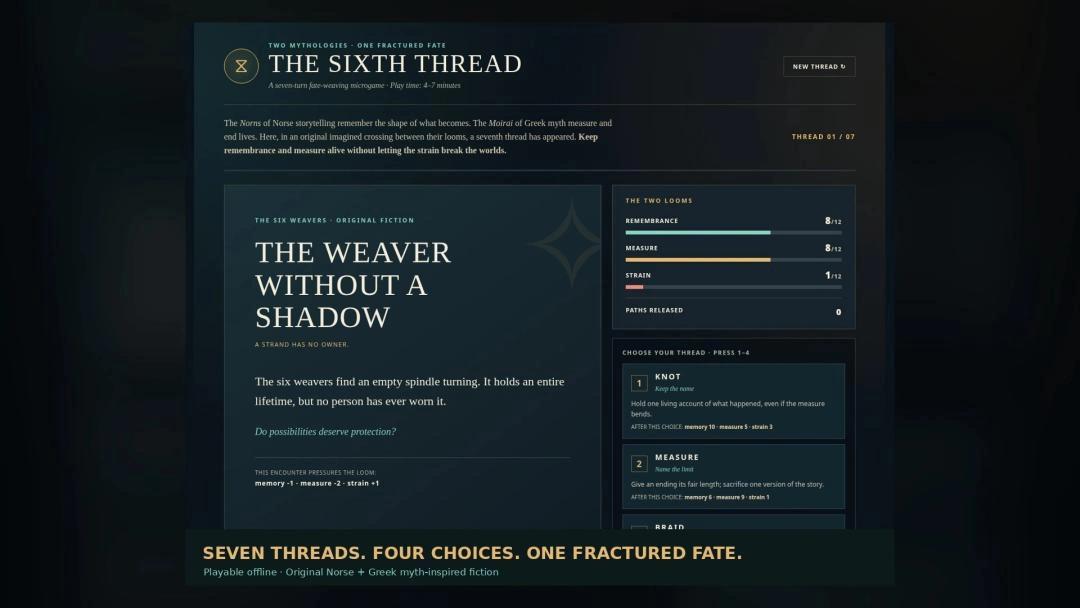
One challenge in making The Sixth Thread was giving meaningful consequences to a story that players can finish in only a few minutes. Short interactive fiction cannot rely on dozens of scenes to teach its rules. The choices need to communicate both an immediate dramatic action and a consequence the player can understand. We used four recurring decision types, KNOT, MEASURE, BRAID, and RELEASE, rather than inventing a completely new interaction for every scene. The story also tracks a small number of values, including remembrance and strain. Those recurring elements give the decisions a shared vocabulary.Lesson 1: Describe each choice as a state transition before writing its dialogue
For every choice, ask three questions. What changes immediately? What does the player gain or sacrifice? Which later scene or ending can reflect that change? If a choice has no observable consequence, it may be functioning as flavour rather than a meaningful branch. That can be perfectly valid, but it should be an intentional design decision.Lesson 2: Make trade-offs understandable
In our design, RELEASE can reduce strain while consuming remembrance. It provides relief at a cost. This is more interesting than a universally beneficial option because it asks players to decide which resource matters most in the current situation. For other narrative games, the same principle could involve exchanging time for trust, safety for information, or immediate progress for a future opportunity. The specific resource matters less than making its consequence coherent.Lesson 3: Separate narrative quality from logical consistency
A branching story benefits from two different reviews. First, inspect the decision rules as a small state-transition system: check reachable outcomes, resource limits, and whether the ending conditions are internally consistent. Second, read the resulting paths as a player would. Do the choices feel understandable, and do their consequences support the story? Passing a logical review does not prove that players will enjoy a branch. Equally, strong writing cannot compensate for an ending that contradicts the player's earlier decisions.Lesson 4: Keep complexity proportional to playtime
Seven decisions do not need an elaborate RPG character sheet. Repeating a few understandable mechanics can create more coherence than introducing a different system in every scene. The broader takeaway for small indie teams is to begin with a compact decision table, identify the meaningful trade-offs, and only then expand the prose and interface around them. This approach is useful for dialogue prototypes, game-jam stories, and short branching experiences. The Sixth Thread was developed with AI assistance in its narrative and code. These are design principles illustrated by the project, not claims of independently measured improvements in player satisfaction or retention.Play The Sixth Thread
- The Sixth Thread on itch.io (opens in a new tab)
- GameForward Mythos Collide jam entry (opens in a new tab)