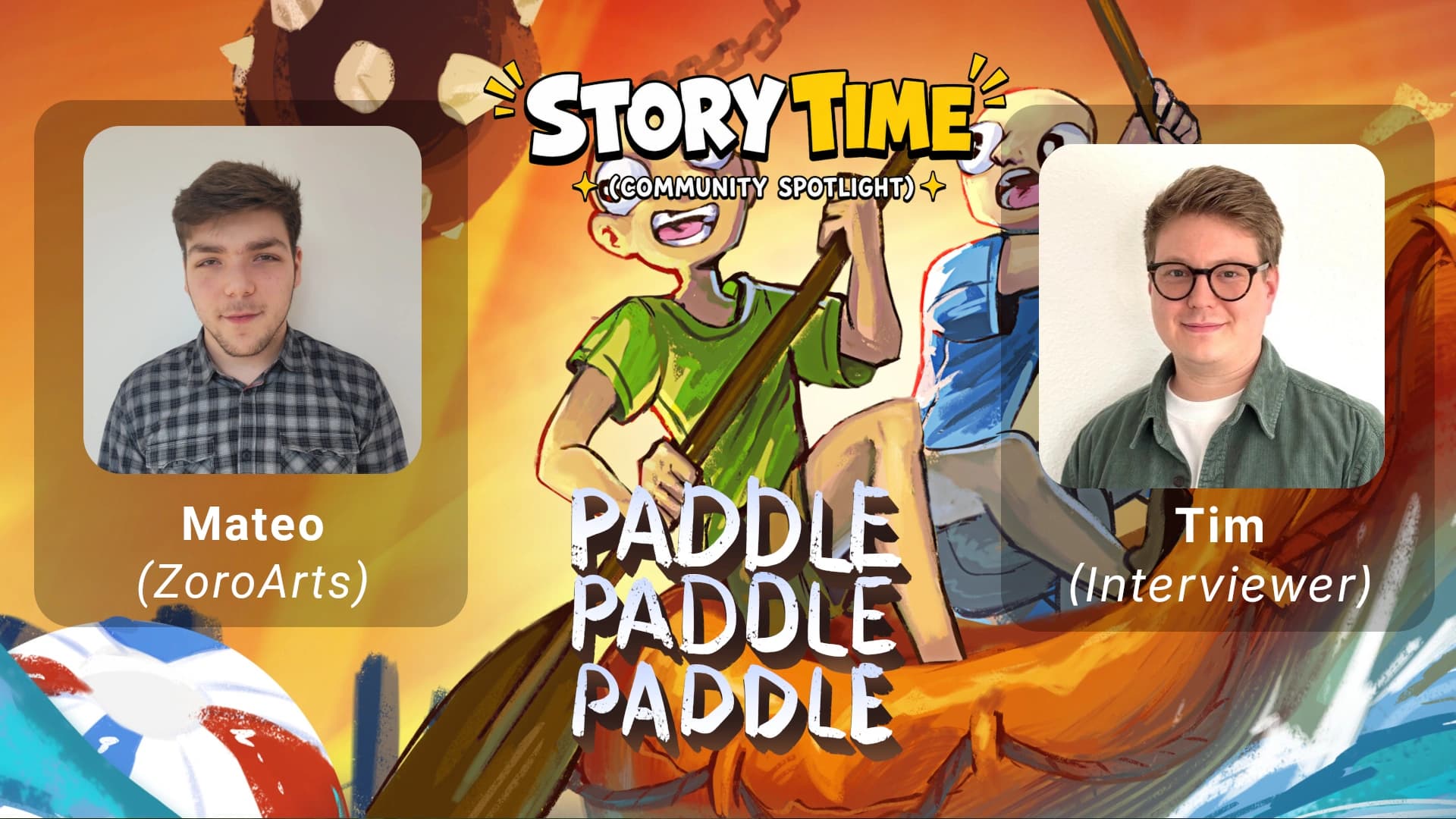
Paddle Paddle Paddle - Mateo's Path to the Next Indie Hit

I interviewed Mateo from ZoroArts about his start and progress as a solo game developer, talking about dream projects, early failures, and his first big success.
By Tim UhlottFounder|Last updated: May 21, 2026|15 minutes read
community spotlightindieinterview
Paddle Paddle Paddle - Mateo's Path to the Next Indie Hit
1. Tim: Great to have you here, Mateo! How did you get into serious game development in the first place? Mateo: It started during the Corona time, around 2020 or 2021. Because of homeschooling, I was sitting alone in front of the PC for nine hours a day for online lectures. I wanted to learn something productive next to that, not just play games. On YouTube I found channels like Thomas Brush and Jonas Tyroller, who motivated me with their own indie projects. I had been playing video games since I was twelve, but I had also always been drawing. I wanted to bring my drawings to life and turn them into games. I started with game jams and very small projects, at most one week of development each, mainly to learn how to take a project from start to finish in Unity with C#. My first real success was a small endless runner that I built in a week and released on Android and iOS. I kept doing small projects for about a year, and after that year of prototyping I started my first real game, Makis Adventure. 2. Tim: Had you programmed before, or did you start coding when you started with games? Mateo: I started programming when I started with games. Before that I had never touched code. I always hated math and was never good at it, so programming was very hard for me at the beginning. My brother helped me a lot. He works in IT and cyber security, so he is very experienced. He taught me C#, helped me get into Unity, and supported me throughout the journey, especially on the programming side. 3. Tim: What drew you to C# and Unity instead of Unreal with C++ or Godot? Mateo: Back then there was not much else. Unity and Unreal were the top engines, Godot was barely relevant yet, and Game Maker 2 had no good docs and no real community. Unreal never appealed to me because I do not want to build hyper-realistic 3D games like GTA, I want to build small, fun projects. For that, Unity was simply the better tool. Unity was also still pretty rough back then with a lot of bugs, but it has become much more usable over the years. 4. Tim: Which game first made you think "I want to build something like that"? Mateo: As a kid I really loved Pokemon Pearl because I am a huge fan of pixel art, that is also why Makis Adventure became a pixel art game. My biggest inspirations early on were Wind Waker from the Zelda series and Pokemon Pearl. I wanted to combine my favorite aspects from different games: the platforming from Hollow Knight, the exploration and world-building from Zelda, and the pixel art style from Pokemon. On top of that, I love sharks, so the main character became Maki, the shark demon, swimming through a 3D water hub world full of NPCs and minigames, with combat only in the dungeons. 5. Tim: You mentioned that your brother helped a lot. Did you ever build a game together with him? Mateo: He helped me a lot, but we have never actually built anything together. He is just not really interested in game development. If he ever wanted to, I would happily do something with him, but he is more in his own field and I am in mine. 6. Tim: So all your games so far have been solo. Do you plan to work in a team in the future? Mateo: I really enjoy solo development, but I would also like to have someone in the team eventually. Right now though, I have running projects, and I think it only makes sense to bring someone in at the very beginning of a new project, when the vision and concept are not locked in yet. For my new game the demo is already done, so the concept is set. Maybe in a few years, when I tackle something huge like a 3D Makis Adventure, I will absolutely bring people on board. For now, not yet. 7. Tim: After Makis Adventure you switched from a big adventure game to the coop chaos game genre. How did that shift happen? Mateo: There was actually a step in between. After releasing Makis Adventure I worked on the game for another full year, adding a multiplayer mode, a level editor, a boss rush mode, and lots of community-driven content to polish it. After that I started a roguelike called Rogue Jungle, but I was almost at the finish line when I had the idea for Paddle Paddle Paddle one morning in the shower. The trigger was real life. Two years ago I was on the beach in Croatia with my brother and we tried out a paddle boat. He could paddle well, I could not, and we just spun in circles. I realized how perfect that real-life teamwork challenge would be for a coop game, especially while games like Carry the Glass, Share It Together, and Only Up were going viral. I built a prototype in two to three hours in Unity, with a basic 3D boat asset and a quick clip of four seconds of paddling gameplay. I posted it the same day saying "this morning I had the idea for a coop paddle game" and the tweet hit 70,000 views, a publisher messaged me, and the streamer Frank Roy asked for a demo right away. That early signal told me to keep going. 8. Tim: When did your current publisher come in? Mateo: Right at the start, another publisher reached out, but the call did not really click because I had no milestone plan and was running on pure spontaneity. They wanted more structure, and I said maybe on the next project. Assemble Entertainment messaged me about a month after the demo went out, around three quarters into development, when I was already finalizing things. They came in for marketing, localization, and everything else around the launch. 9. Tim: Did you suspect Paddle Paddle Paddle could go viral, or was the genre fit accidental? Mateo: These days I deliberately pick genres that fit me and that players currently enjoy. I already built my dream game with Makis Adventure, so I am done with that bucket. Now I want shorter projects, three to four months, that are fun to make and that I can ship without burning out. The market reality is that as an indie you have to go for volume. People expect indie games to be cheap. I have seen too many negative reviews where the game is great but the price is "too high" at twenty euros. So unless you are Nintendo, you are better off selling a five-euro game well than a thirty-euro one. Paddle Paddle Paddle was a deliberate fit with the viral coop genre, but it also came from a real personal experience with my brother on that boat. 10. Tim: Mobile is a tough market. How are you approaching it for Paddle Paddle Paddle? Mateo: Mobile is brutal because you basically have to spend money to make money, the market is saturated with ads. The exceptions are games like Balatro, Vampire Survivors, or Enter the Gungeon that built their hype on Steam first and then carried that community over to mobile. That is the path I am taking. I built Paddle Paddle Paddle from day one with big buttons so the UI works on phones without changes. I use Photon for multiplayer, which gives me crossplay out of the box, so phone, PC, and console players can all play together. The mobile version is technically uploadable today, I just still need to integrate Game Center and Play Games achievements and leaderboards. It is planned for mid to late this year. 11. Tim: Was there a moment during the Paddle Paddle Paddle development where you thought "this is not going to work"? Mateo: Honestly, almost never. The early signals were too strong, the prototype tweet, the streamer interest, the publisher reaching out. My only real worry was whether the actual Steam community would receive it well, because Steam players tend to be more serious than the brain rot crowd on Twitter. But the demo was downloaded 100,000 times before launch, played by some of Germany's biggest streamers, and the demo reviews came in around 500 very positive. After that, my last bit of doubt was gone. 12. Tim: Has the success changed your daily life? Mateo: Mainly that I am even happier and have financial security now. But day to day, almost nothing has changed. I still develop ten hours a day. I want to slow down a bit during summer and go outside more, but my routine is essentially the same as before. I do not even play games anymore, I would rather develop. The motivation is much higher now because I know that whatever I post or update will actually be played by real players, immediately. That is very different from the early days, when a new release on itch.io got three downloads. 13. Tim: After Paddle Paddle Paddle you released Cool Story Bro! in just one month. How did that come about? Mateo: I started Cool Story Bro! on March 15, the actual development was three weeks plus one week of polish, trailer, playtesting, and waiting for Steam to approve the page manually. I wanted to do everything myself this time, no publisher, including PR and marketing. I learned a lot of new things: writing a press release, sending out around 1,300 Steam keys to creators using YAMM (Yet Another Mail Merge), an email mailing automation that uses your Gmail account so the deliverability is essentially perfect. The game itself is a party story-writing game, somewhere between Liar's Bar and Cards Against Humanity, but with free writing instead of cards. I wanted to mix Mario Party with social story writing. You get four random words and an optional genre and write a short story, while between rounds you play type-racer minigames to win items that let you mess with other players. It financially recouped its development time in a month, which makes it a success for me, and it taught me the full marketing pipeline. 14. Tim: You handled marketing yourself this time. What did you learn, and what works best? Mateo: Connections, by far. I have personal contact with two huge accounts: JackLucky on Twitter with around 500,000 followers, who loves to share indie games, and an editor at Dexerto with millions of followers. They posted my trailers, and on launch day I had over a million views on Twitter through them alone. I have basically zero reach myself, so leveraging people who genuinely enjoy sharing indie projects is the entire game. Cold emails are mostly a dead end. Streamer emails are read by their management, not the streamer. Twitter DMs to private accounts get read by the actual person. That is how I got DomTendo, Maxify, and a Gronkh showcase, all through DMs or LinkedIn connections to management. The framing matters too: do not pitch like a salesperson, just say "I built this cool local project from Duisburg" and people are much more open, especially in the German scene where the local angle resonates. 15. Tim: What do solo developers underestimate, and what advice would you give to new indie developers? Mateo: Conventions are the hardest. Twelve hours alone at a booth, no spind, no one to relieve you, that is brutal. I will be at Gamescom this year and I have no idea yet how I will manage. The pro tip there: stand behind the player, do not introduce yourself as the developer at first. You get much more honest feedback that way, and you can reveal it afterwards. The general challenge of solo dev is constantly switching hats, marketing in the morning, programming all day, then back to filming a TikTok in the evening. That role rotation is exhausting. For new devs my advice would be: start small, your first game will fail, that is normal. Build prototypes, then make a full itch.io page for each one to learn how to write a description, design a cover, build a logo, capture screenshots, and cut a trailer. Build a long-term Twitter or social account, not a new one per game. You need wishlist momentum to launch, ideally 8,000 to 10,000 wishlists. Go to local dev meetups and conventions, that is where I met everyone in my circle today, including the friends I now share a Discord with for marketing tips and convention coordination. Connections are everything, in indie dev as in any other industry. Links: You can find Mateo's games on his Steam developer page. Get Paddle Paddle Paddle on Steam and check out Cool Story Bro! on Steam. To connect with Mateo you can find him on Twitter.

Share this article

Frequently asked questions

More on this topic

Newsletter

Stay in the Loop.

Subscribe to our newsletter to receive the latest news, updates, and special offers directly in your inbox. Don't miss out!