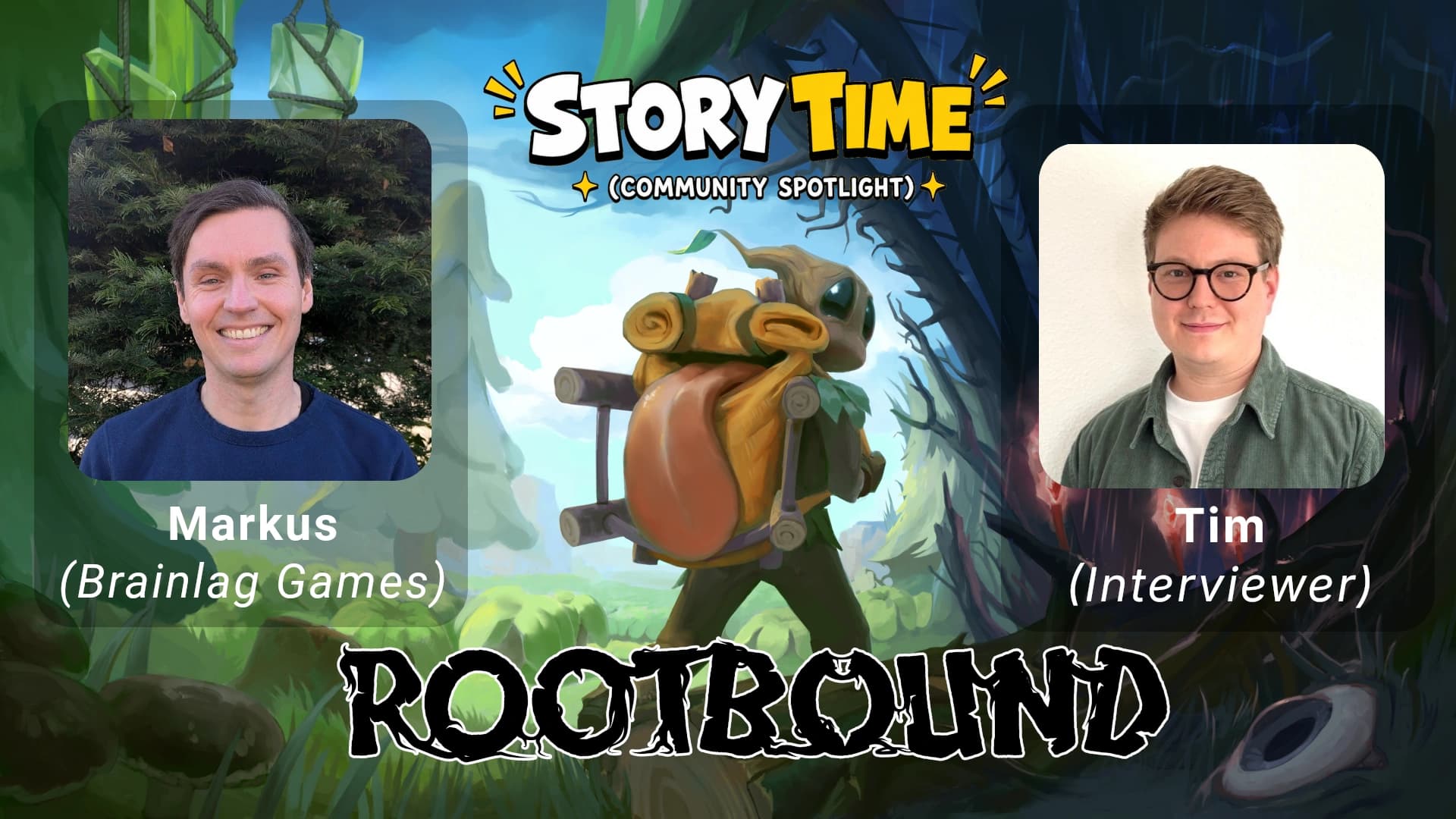
Interview with Markus from Brainlag Games about Rootbound

I talked to Markus from Brainlag Games about founding an indie game studio after Piranha Bytes, building their first game Rootbound.
By Tim UhlottFounder|Last updated: May 14, 2026|12 minutes read
community spotlightindieinterview
Interview with Markus from Brainlag Games about Rootbound
1. Tim: Great to have you here, Markus! Could you say a few words about yourself? Who are you and what do you do? Markus: I am Markus, and together with three former colleagues I founded our own game studio. Before that, I worked at Piranha Bytes. When the studio was closed, we suddenly found ourselves out of work and decided to build something of our own. That became Brainlag Games. 2. Tim: How did you get into the games industry? Markus: In a very classic way, actually: I applied. Many people say it is hard to get into the games industry if you do not know anyone. As a programmer, it apparently worked out for me. After a work-and-travel stay in Australia, I had time to think about my career. I realized that I wanted to do more with gaming again. So I applied and was honest about the fact that I only had some Unity experience, but that I could program very well and was a passionate gamer. Piranha Bytes gave me the chance. 3. Tim: So your start was directly at Piranha Bytes, right? Markus: Exactly. From the perspective of the games industry, I was a complete career changer. I had studied computer science and had previously worked in the public-sector area at an IT service provider. That had nothing to do with games. At Piranha Bytes, I worked on Elex 2. Compared to a large company, the studio was much smaller, more personal, and more flexible. Communication paths were short, working hours were very free, and there was a lot of trust. At times, I even felt like nobody had reviewed my work in detail for months, and in the end it was simply in the game. That was a great feeling. 4. Tim: What happened with Piranha Bytes, and how did the founding of Brainlag Games come about afterward? Markus: Piranha Bytes had already been a wholly owned subsidiary of the Embracer Group for some time. At the end of 2023, Embracer had to make major cuts, and many game studios were closed, especially those with unannounced projects. Piranha Bytes was one of them. After that, there were still attempts to save the studio and find another publisher, but that did not work out. I still wanted to stay in the games industry. At first, I started learning engines like Godot and worked on ideas with former colleagues. An initial attempt with a larger group did not work, mainly because people had very different amounts of time available. After that, we said: if we do this again, everyone has to be in 100 percent. That is how the four of us started. 5. Tim: The four of you then founded Brainlag Games. How did that process work? Markus: We started working on our game in June 2024. The company founding came shortly afterward. First, we wanted to see whether the game worked and whether we worked well together as a team. After about two months, it was clear: this fits. Then we started the founding process and officially founded the company in October. The timing was also tactical, because we wanted to use the start-up grant from the employment agency. For that, we still needed to have enough entitlement to unemployment benefits left. That allowed us to finance the first few months and work full-time on the game. 6. Tim: When you found a game studio, do you organize yourselves like a classic startup with CEO, CPO, and similar roles? Markus: There are two levels for us. On the game development side, the roles are fairly clear because of our skills: two programmers, one story and game designer, and one artist. On the company side, we are all equal. We are all shareholders and managing directors. There is no hierarchy where one person decides everything alone. That said, we still split responsibilities, usually in a way where no single person is solely responsible. Finances, marketing, or publisher talks are each handled by two people so that we can cover for each other. 7. Tim: Which part of that do you take on? Markus: I am involved in many topics. I have led publisher talks, I am involved in finances and other managing-director topics, and I support marketing. In general, we make many decisions together. We work together in Discord all day, almost like in an office. You are not talking constantly, but when something needs to be clarified, the communication paths are extremely short. 8. Tim: Does this democratic structure make decisions easier or harder? Markus: So far, we are handling it well. Of course, there are heated discussions sometimes, but that also shows that everyone is passionate about it. For emergencies, we have a veto or tiebreaker system: for certain areas, there is one person who would be allowed to make the final decision if we were completely unable to agree. So far, we have not had to use it. Ironically, the hardest discussion was about the company name. At some point, we had hundreds of names on a list and thought almost all of them were bad. In the end, we chose the one that was the least bad. By now, it fits us. 9. Tim: How are you financing yourselves? You first had the start-up grant and then additional funding, right? Markus: Exactly. We only had the start-up grant from the employment agency for a short time, because after that we received a scholarship from the Federal Ministry of Culture. It ran for a year and a half and secured a large part of our work, even though money remained tight. Later, we received production funding from the state of North Rhine-Westphalia in Germany. That covers 50 percent of production, in our case 300,000 euros. We still have to finance the other 50 percent elsewhere, but we are optimistic. 10. Tim: How does that kind of funding process work? How do you approach it? Markus: For example, you contact the Film- und Medienstiftung NRW in Germany and ask for a consultation appointment. They explain what you need to submit. After that comes an extensive application: a project description, basically a game design document, financial planning, and additional documents. Our document was about 60 pages long. You have to explain what the game is, how the money will be used, and why the project is culturally relevant. In our case, Nordic-Germanic mythology played a role, among other things. In the end, a jury decides. The important thing is that, since the change in the rules, this funding is a real grant and no longer a repayable loan. 11. Tim: Let us get to the most exciting part: what exactly are you building with Rootbound? Markus: For us, Rootbound is an exploration adventure. In the past, we might have called it an action adventure, but the focus is not on combat and action. You can imagine it a bit like the modern Zelda games, Breath of the Wild or Tears of the Kingdom, but with a fixed isometric perspective and, of course, a much smaller budget. The world should feel open and playful. Many objects have weight: if something is light enough, you can pick it up, throw it, or put it in your backpack. That even applies to enemies. In principle, anything you can pick up can also be used as a weapon. 12. Tim: The backpack sounds especially interesting. What is it all about? Markus: The backpack is a central part of the game. It is alive, has its own will, and is not simply an inventory. You have to learn to cooperate with it. You can throw things to it, and it will pack them away. If it does not like something, it spits it back out. If you annoy it too much, it may even spit things in your face or temporarily refuse to cooperate. But it is not supposed to become annoying. Most of the time, it naturally does what you need, but there should be situations where this relationship becomes interesting in gameplay terms. Its name is Nimo, derived from the Japanese word "Nimotsu," meaning luggage or package. 13. Tim: How did you come up with the idea of a living backpack? Markus: At the beginning, we simply wanted to have a backpack that you could set down. An inventory that physically exists in the world and can also be used for puzzles. At some point, the question came up: what if this thing were alive? The idea developed from there. There was no direct reference. Around that time, I was reading Terry Pratchett, where there is a living chest that follows the wizard Rincewind. Maybe part of the inspiration came from that subconsciously, but it was not planned. 14. Tim: Is there anything from Gothic, Elex, or Piranha Bytes in Rootbound? Markus: Definitely. Our game designer and story writer worked at Piranha Bytes for about 13 years, and our artist worked there for around 25 years and was already part of Gothic 1. I spent four years there myself, so by comparison I am the youngster. You cannot simply remove that influence. Rootbound has a lot of story, a lot of text, and decisions you can make. That is probably where you will notice a Piranha Bytes feeling. At the same time, we deliberately did not want to make a new Gothic or a Piranha Bytes-style role-playing game. We wanted to build something we all truly stand behind, not simply repeat something that some of us may already have been burned out on. 15. Tim: How do you market a game like this, and what advice would you give to people who want to get into the games industry? Markus: Marketing is extremely important and has to start early. We are active on many platforms: Twitter, TikTok, Instagram, YouTube, and Reddit. Sometimes you post 20 things and 19 of them do nothing, but one post suddenly gets 500,000 views. Then there are showcases, Steam events, Gamescom, and contacts in the industry. The Piranha Bytes background helped us a lot in the beginning, for example with press articles and Steam wishlist numbers, but the rest comes from continuous work. Anyone who wants to get into the industry should go out, network, look for funding, and talk about their own project early. The games industry is very open and helpful, but you have to ask and make yourself visible. Links: Wishlist the game on Steam. You can find more information about Brainlag Games and Rootbound on the website. To connect with Markus you can find him on LinkedIn. The interview got summaries and translated from German to English. You can hear the full interview (original German version from my Podcast "No Bullshit Founders") on Spotify.

Share this article

Frequently asked questions

More on this topic

Newsletter

Stay in the Loop.

Subscribe to our newsletter to receive the latest news, updates, and special offers directly in your inbox. Don't miss out!