SIM Swap Attacks: How They Work and How to Protect Yourself

Learn how SIM swap attacks work, why they're so dangerous, and what you can do to protect yourself before it's too late.

By Hirum KigothoTeam|Last updated: August 21, 2026|9 minutes read
cybersecurity
SIM Swap Attacks: How They Work and How to Protect Yourself
Your mobile phone number is more than a way for people to call or text you. For many people, it has become a key to their digital identity. Banks, email providers, social networks, cryptocurrency platforms, and other online services frequently use phone numbers for password recovery and multi-factor authentication (MFA). That makes a mobile number a target for cybercriminals. One of the most effective ways attackers exploit this is through SIM swapping, also known as SIM hijacking or SIM-swap fraud. This article examines how SIM swapping attacks work, the security risks they pose, and effective ways to prevent them. Understanding SIM swapping can help reduce the risk of identity theft, account takeover, and financial fraud.

What Is a SIM Swap Attack?

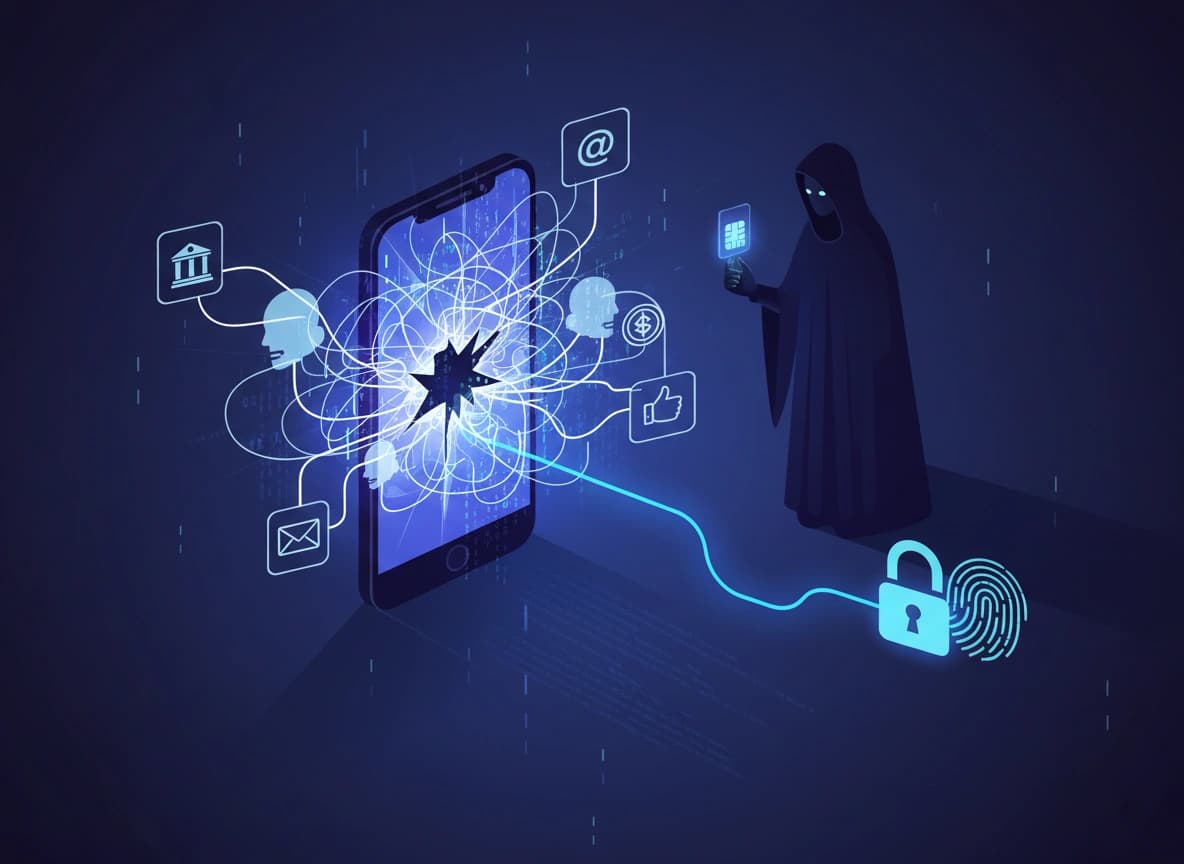
SIM swapping is a sophisticated cyberattack in which criminals hijack a victim’s mobile phone number to gain access to sensitive accounts and information. The attacker usually deceives or manipulates a mobile carrier into transferring the victim’s number to a SIM card they control. Once the transfer is complete, the attacker can receive SMS-based two-factor authentication codes, intercept calls and messages, and reset account passwords. The attacker does not necessarily need physical access to the victim's phone. Instead, they may obtain enough personal information to convince a carrier representative that they are the account holder. The FBI says criminals have used social engineering, phishing, and, in some cases, insider assistance to carry out SIM swaps. Once the number is transferred, the attacker can receive calls and SMS messages intended for the victim. That is very dangerous when SMS messages are used as a second authentication factor.

How SIM Swapping Works

A typical attack can unfold in several stages.

1. The attacker gathers information

The first step is often reconnaissance. Attackers may collect information about a target from social media, data breaches, phishing campaigns, leaked databases, and other sources. They may look for the victim's name, phone number, email address, date of birth, address, carrier, and other information that could help them impersonate the victim. Publicly available information can sometimes make social engineering easier.

2. The attacker targets the mobile carrier

The criminal then contacts the victim's mobile carrier, either through customer support, an online process, or a physical retail location. The attacker may claim that the victim lost their phone, damaged their SIM card, or purchased a new device. The objective is to persuade the carrier to move the victim's number to an attacker-controlled SIM or eSIM.

3. The phone suddenly loses service

If the fraudulent transfer succeeds, the victim's SIM is usually disconnected from the cellular network. The victim may suddenly see:
  • No cellular service
  • No ability to make or receive calls
  • No incoming SMS messages
  • Unexpected carrier notifications
  • An unexplained loss of mobile data
A sudden and unexplained loss of cellular connectivity can therefore be an important warning sign.

4. The attacker receives SMS codes

After taking control of the number, the attacker can receive SMS messages and voice calls that were intended for the victim. This is where the attack can escalate quickly. Suppose an attacker already knows your email address and password. If your email provider sends a login verification code to your phone number, the attacker may now receive that code. The attacker can use the same technique against banking, cryptocurrency, social media, and other accounts.

5. Accounts are taken over

The attacker may attempt password resets, account recovery procedures, or new-device logins. If the victim's phone number is the primary recovery mechanism, the attacker may be able to change passwords and other security settings.

How to Protect Yourself

As the threat of SIM swapping continues to grow, businesses and individuals should adopt these security measures to reduce their exposure and protect themselves.

Move away from SMS-Based MFA

Multi-factor authentication is still one of the most important defenses against account takeover. However, not all MFA methods provide the same level of protection. The weakness of SMS-based MFA is that the authentication code is delivered through the phone network. If an attacker controls the victim's phone number, the attacker may receive the same code that was supposed to protect the account. That does not mean you should disable MFA if SMS is your only available option. SMS MFA is generally better than having no second factor at all. But where stronger options are available, they should be preferred.

Use an Authenticator App

One alternative is an authenticator application that generates one-time codes directly on your device. Instead of receiving the code through SMS, the application generates it locally using a previously established secret. This means an attacker who merely takes control of your mobile number does not automatically receive the authentication codes. Authenticator apps are therefore generally more resistant to SIM-swap attacks than SMS-based verification. However, users should still protect the device and account containing the authenticator carefully and maintain appropriate recovery options.

Use Passkeys or Security Keys

For your most important accounts, consider moving beyond SMS and one-time passwords. Security keys and passkeys can provide phishing-resistant authentication because they rely on cryptographic credentials rather than simply sending a code that a user can enter into a website.

Mobile Carrier Providers Should Do More

Mobile carriers should strengthen identity verification procedures before activating replacement SIM cards or transferring customers’ phone numbers. They should also provide training for customer service staff to recognize suspicious requests and stop fraudulent SIM-swapping attempts before they succeed.

Reduce the Amount of Personal Information You Publish

Attackers do not necessarily need sophisticated malware to perform a SIM swap. Social engineering can be enough. Every publicly available piece of information can make impersonation easier. Avoid unnecessarily sharing sensitive personal information online, including your full date of birth, personal phone number, home address, detailed information about family members, financial information, or details about valuable assets. You do not need to disappear from social media altogether; instead, limit the amount of personal information available publicly so attackers have fewer identity-verification clues to exploit.

Protect Your Email Account First

Your primary email account deserves special attention because it can often be used to reset passwords for other services. If an attacker gains access to your email, they may be able to intercept password-reset messages, change account credentials, and lock you out. Where possible, protect your email account with a passkey, security key, or another phishing-resistant authentication method. You should also regularly review your recovery email addresses, recovery phone numbers, logged-in devices, active sessions, email forwarding rules, account-recovery settings, and recent login activity. If an attacker gains access to your email account, they may attempt to maintain persistent access by changing recovery information, adding their own devices, or creating forwarding rules that secretly redirect your messages.

Training

Increasing awareness of SIM swapping and its associated risks is important for both individuals and organizations. Employees and users should be educated about how these attacks work, the warning signs to watch for, and the steps they can take to protect themselves. Regular cybersecurity training and ongoing reminders about security best practices can help reduce the likelihood of falling victim to SIM-swapping attacks.

Conclusion

SIM-swapping scams are part of social engineering and account takeover attacks. Attackers rarely rely on a single technique. Instead, they may combine phishing, doxing, and SIM swapping to create a chain of compromises that enables them to gain access to sensitive accounts and information. The growing adoption of eSIM technology adds another layer of complexity. Although eSIMs eliminate the need for a physical SIM card, they rely on digital processes for activating and transferring mobile numbers. If these processes are not adequately secured, attackers could potentially exploit them to carry out fraudulent transfers. For organizations, SIM-swap fraud shows the fact that the attack surface extends beyond networks, applications, and devices. Human error, weak identity-verification procedures, and continued reliance on vulnerable authentication methods can all provide attackers with opportunities to compromise accounts.

Share this article

Frequently asked questions

Newsletter

Stay in the Loop.

Subscribe to our newsletter to receive the latest news, updates, and special offers directly in your inbox. Don't miss out!