Why security as a product is a problem
Let's face it, we all love the idea that security (or anything else) can be simply purchased. It feels good. You hand over money, get the thing, and the problem is now considered "handled," without any effort or the need to change your behavior. Just "buy a tool" sells better than "change how you work every single day." That is not how security works. If you buy a lawnmower and do not actually use it, the grass will still be tall. If you put a lock on an open door, it is still open. Simply having a seatbelt in your car will not help you either. You get the idea. Trust me, this problem is real, and I can imagine that maybe even you’ve experienced it yourself. And now that we know where this problem is coming from, let’s deep dive into it.Hackers target people, not tools
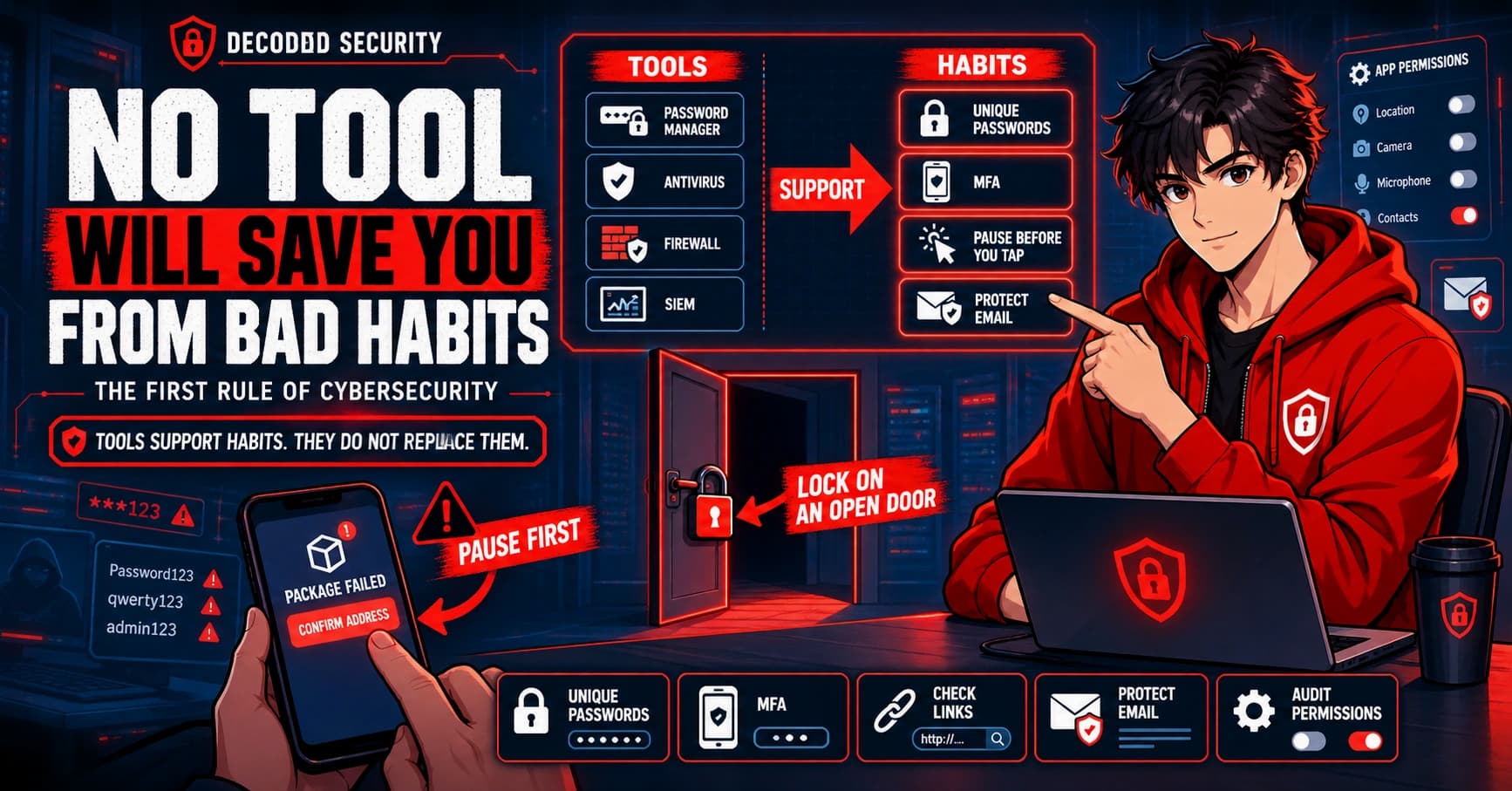
Hackers, attackers, or threat actors care about results. In some sense, they are like any other business. They want to get what they want (usually money) for the least effort possible. Like it or not, we humans and our behavior are the weakest link in many systems. Breaking an encryption algorithm is much harder (often impossible) than convincing someone to click a link that promises them one extra week of vacation a year. And I know, maybe you think you are too smart to fall for these scams. The statistics say you are not. Picture it yourself. A normal Tuesday evening. You are tired, half watching something, phone in hand. A message pops up: "Your package could not be delivered, confirm your address here." You tap it without thinking, because you actually are waiting for a package. That is the whole attack. No firewall was defeated. No password was cracked. You just did not pay attention for a second, and that was enough. If you want to know more about why smart people fall for dumb scams, read The psychology of hacking (opens in a new tab).Remember: You do not get hacked because you are important. You get hacked because you were easy that day.
Top 5 security habits that anyone should do
Okay, that was enough general lessons that maybe sound interesting, but do not help you at all. I want to tell you about five personal habits that have the biggest impact on the security of your identity, your accounts, and your digital life. And the good news is, it is easier than you think.Use unique passwords
Never reuse your password. Each account deserves its own unique password. Why? Because breaches happen all the time, and you will never find out about all of them. When one site leaks, every other account that shares that password is suddenly open.Turn on two-factor authentication
Even a strong, unique password is not enough anymore. Credentials can be stolen, and the second layer of protection is exactly what separates you from an easy target. Attackers go for easy. Make your accounts a little less easy.Pause before you tap
This is probably the hardest one to implement. It takes time, but it can really save you the trouble. Before you click that link, check the sender. Think about it for two seconds. If something starts feeling off, verify it first.Protect your email first
Your email account is your digital passport. If someone gets access to your email, they can get access to nearly all of your other accounts. So if there is one account you really should protect, it is this one. Unique password. Two-factor authentication. No exceptions.Audit your app permissions
Once in a while, check the app permissions on your phone. You will be surprised. A flashlight app with access to your gallery. Why? Remove everything that is not essential, and be extra careful about location, camera, and microphone access.Tools help. They do not replace the habit
Let me be clear before we finish. I am not saying tools are useless. I use plenty of them every single day, and so should you. A good antivirus, a password manager, a solid backup. These things genuinely help. But they help the way a good pair of running shoes helps. They make it easier to run. They do not run for you. That is the whole point. Tools are here to support your goals, not to replace your effort. They remove the friction so the smart choice becomes the easy choice.Example 1: unique passwords and MFA
Use unique passwords and MFA. Both become much more convenient when you use a good, secure password manager.| Piece | What it is |
|---|---|
| The goal | Secure my accounts |
| The habit | Use unique passwords and MFA |
| The tool | A password manager |
Example 2: pause before you tap
Pause before you tap, and support that habit with a SecureDNS service.| Piece | What it is |
|---|---|
| The goal | Avoid clicking malicious links |
| The habit | Pause before you click |
| The tool | SecureDNS |