Building the Tools Behind Lost Ball

Knut Harald Ryager is remaking Lost Ball with a custom physics engine and level editor in Unity. A free demo is out next month for Steam Next Fest.
By Knut Harald RyagerGuest|Last updated: October 1, 2026|5 minutes read
community spotlightindie
Building the Tools Behind Lost Ball
I'm Knut, programmer and the solo developer behind Lost Ball, a 2D physics puzzle-platformer built around interconnected physics systems such as destructible terrain, fluids, fire/melting, optics, and gravity/magnet fields. The basic gameplay is that you roll a ball and jump/boost across platforms. Each level introduces a new ability that changes how you play, interact with the world, and solve puzzles. You can use a magnet to roll on metal ceilings, fly in the wind with a parachute, create portals, reverse time, suspend gravity, activate machines through circuit systems, control fish with BOIDS swarm AI, or fire laser beams that can burn down the environment and spread/concentrate through lenses.

From Flash to a Unity remake

The game started when I began building my custom physics engine back in high school/university, and the original was completed in 2013, when it won the Norwegian Game Awards "Game of the Year". However it was built in the dying technology Flash, so I just released it as a free web game. Now however, I am remaking it in Unity into a much bigger game, extending from 10 to 20 levels, for a proper commercial release.

Porting the physics engine

My physics engine was ported to C#/Burst, refactored from an object oriented architecture to an Entity Component System, and parallelized for the various physics systems. In Flash, I had to awkwardly cut polygons into pieces to avoid drawing thousands of pixel lengths of them outside the screen, something that is thankfully handled by the Unity/3D engine this time.

A level editor players can share

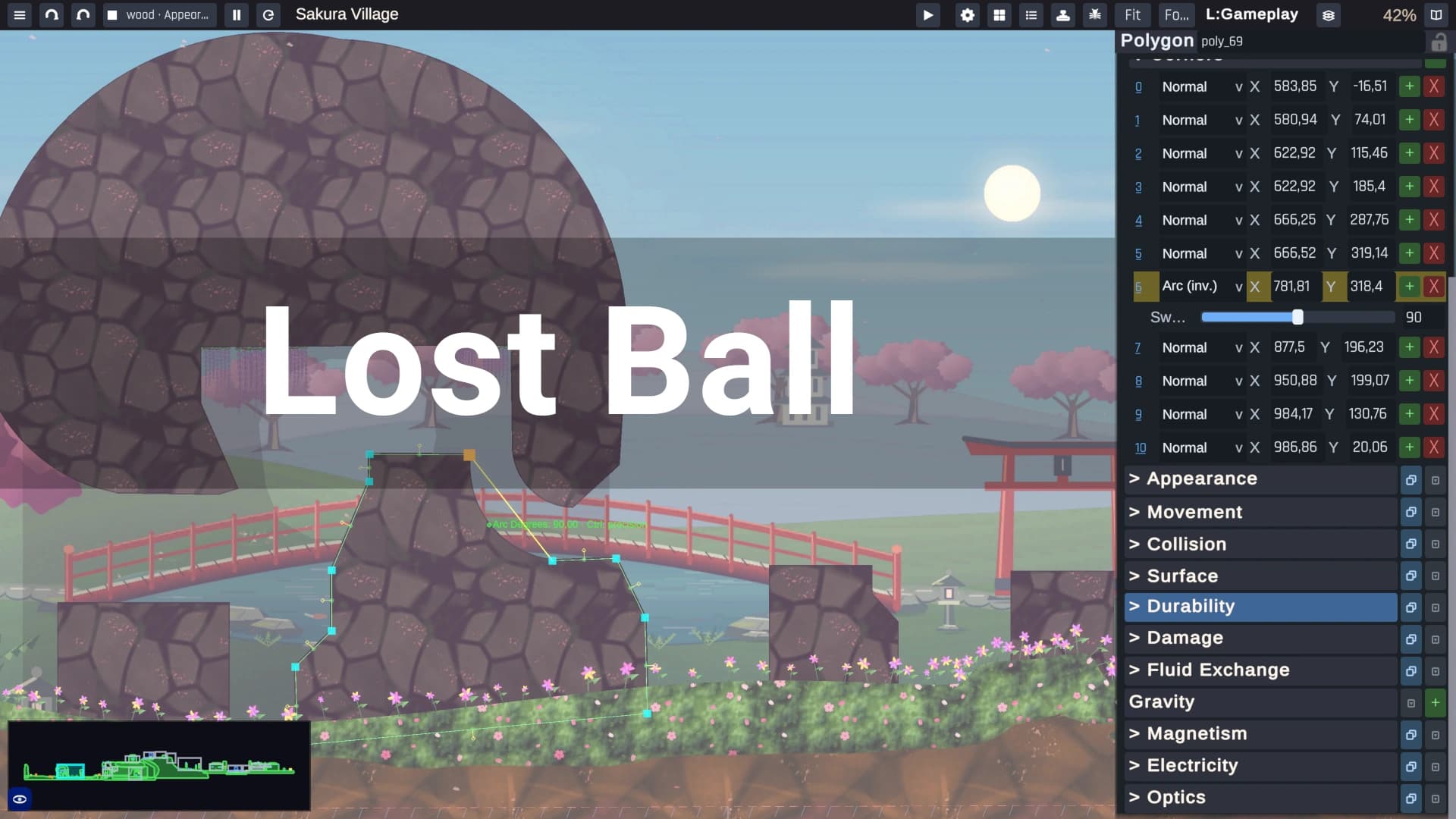
Unlike last time, when I designed levels by typing all coordinates into the game's code, this time I built a powerful level editor which is included, so players can share their own levels. It contains a 2D polygon editor with many operations found in typical 3D modelling software. You can sculpt polygons, select corners/edges and move/rotate/resize/extrude, texture them, and apply properties from the different physics systems. Each polygon edge can also define a curve, or NURBS together with other edges. So while 2D game level editors often use more simple tile engines, I wanted to see what can be achieved by unleashing powerful editing of general polygons and arbitrary smooth curves. There's probably a lot more games than my ball rolling platformer that can be built from this, which you can also try in the editor with the scripting support.

Scripts that load instantly

Fast iteration speed was the goal here, with scripts running in an interpreter inside the game, so no recompilation is needed when testing levels. They load instantly from the editor. Every level you can see in the Steam trailer was built in the game's own editor.

Built with coding agents

As you may have guessed, building all of this alone would be quite the monumental task, until the recent productivity advances in software development. The level editor was built with coding agents, while all the level design was done by me in the editor. It was not some ultimate "1-shot prompt", but rather 15,000 to 20,000 smaller prompts through many iterations. The best advice I can give for this kind of process is to have as many computers as possible to parallelize tasks across to gain more speed and get used to work on many features simultaneously. I also let the coding agents build tens of thousands of unit tests to catch regressions, but this will likely just slow you down for a large part of early development. They will be more valuable later.

Automate the tools, keep the human touch

Automated game development is still somewhat controversial, and I think this might be the best way to go about it. Automate powerful tools, enabling humans to build fast while retaining the human touch. So I am excited to see what people can come up with here. A free demo is releasing next month for Steam Next Fest.

Play Lost Ball

About the author

Knut Harald Ryager is the programmer and solo developer behind Lost Ball, a 2D physics puzzle-platformer he first completed in Flash in 2013 and is now remaking in Unity.
00 views
00 shares

Discussion about this post

Comments are reviewed before they appear on the article.

No comments yet. Be the first to start the discussion.
Frequently asked questions

Newsletter

Stay in the Loop.

Subscribe to our newsletter to receive the latest news, updates, and special offers directly in your inbox. Don't miss out!