AI copycats can lift an unprotected Unity demo in minutes. But pulling the demo also kills the visibility that still sells indie games. Protect the build and keep it public.
By Tim UhlottFounder|Last updated: November 4, 2026|8 minutes read
cybersecurityaiindie
This October, Steam Next Fest was the largest it has ever been. It was also the event where more studios decided a public demo was too risky to ship.The worry is AI copycats. Someone downloads your free build, asks a model to rewrite it, and tries to beat you to the store. That has happened. Pulling the demo, or going quiet on progress, still costs more than it saves.A demo is how players and streamers find you, and how Steam learns your game exists. A devlog is the same habit, earlier. Hide both and you launch into a quieter store. A clone built from a trailer can still show up. You just have fewer wishlists and less public proof that you were first.Protect the build. But keep it public.
Next Fest got huge. Some demos disappeared.
Live counts for October 2026 sat around 7,100 to 7,300 demos, about double June. Coverage that said 8,000 was counting a press preview, before games dropped off the list.
Closed tests help you polish. They do not increase your visibility.
Two kinds of copycat
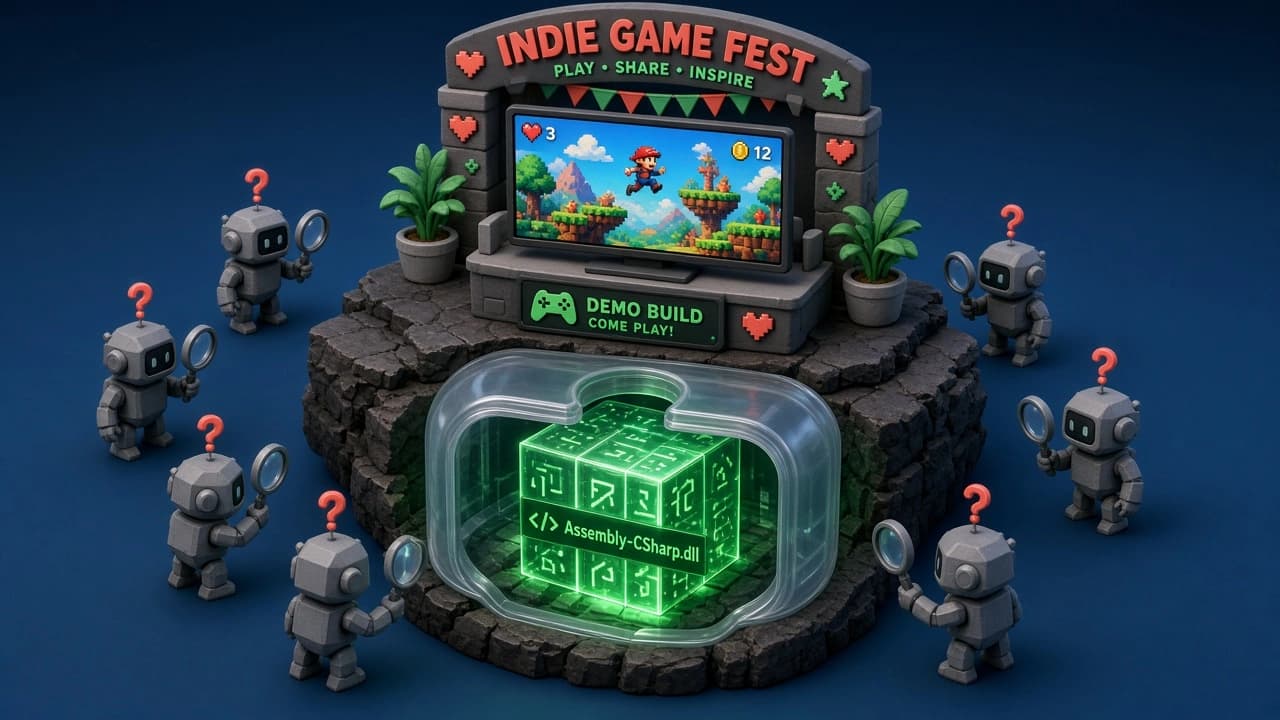
Protection only helps against one of them.Code copy. Someone downloads the demo, opens the files, and reuses your systems. That is the Needle in a Haystack story. Studio Bitdot's Needle In A Haystack Simulator went viral. Kotaku counted at least 14 (opens in a new tab) similar titles. Then NoGlyph, one of those follow-ups, alleged (opens in a new tab) that another game, A Game About Needle In A Haystack, contained code from NoGlyph's 20 and 21 September demo: a namespace called Needlefield.ReferenceHay, 13 classes under the same names, 39 methods that matched instruction for instruction, and error strings that still named a shader from NoGlyph's project. Valve has not ruled on it. Treat it as an allegation. The technical point still stands. The copied build was Unity Mono. The smoking gun sat in Assembly-CSharp.dll.Idea copy. No binary needed. In March, Freya Holmér posted (opens in a new tab) a 50-second rotating Tetris prototype. A vibe-coded clone appeared in under five hours. Game mechanics are generally not copyrightable. Obfuscation cannot stop a clone built from a clip.Decompilers already existed. What changed is cost. A model can turn a dump of named classes and plaintext strings into a new project in an afternoon, as long as the names are there to read.
Hiding the demo is the wrong response
Steam is already crowded. Chris Zukowski counted 20,282 Steam releases in 2025, and only 3% reached 1,000 reviews. Going quiet leaves that market exactly as crowded, with you harder to find in it.Demos are still the visibility lever. Zukowski puts it this way: streamers cannot play a screenshot (opens in a new tab). Parcel Simulator (opens in a new tab) sat on about 7,000 wishlists for roughly 640 days. Then the demo went up, and the game launched with 42,000. In a June 2026 Next Fest survey (opens in a new tab) of 108 games, the median share of demo players who also wishlisted was 19.3%. Four out of five players walk away. The fifth found your page because the demo existed.A devlog is the same loop, earlier. You show unfinished work where players already are. People follow the build, and later they wishlist and play the demo. Pull the demo and stop posting progress, and you give up both ends of that loop. A trailer clone can still ship. Fewer people will know which game was yours.
// Unprotected demo. These names are the map.namespaceNeedlefield.ReferenceHay{publicclassHayDomeRenderer:MonoBehaviour{}publicclassHayExcavationCollider:MonoBehaviour{}}
// After renaming. The systems still run. The index is gone.namespacex{publicclassa:MonoBehaviour{}publicclassb:MonoBehaviour{}}
The "13 identical class names" evidence does not survive that pass.
Protect the build you give away
That is the job of a Unity obfuscator. GuardingPearSoftware Obfuscator runs inside your local Unity build. You press Build, and the demo that leaves the studio no longer carries a labeled copy of your project. It raises the cost, and a cloner racing your launch date depends on the cheap path.Four things matter for a public demo:Renaming. Classes, methods, fields, and namespaces become junk symbols, including MonoBehaviour types, with scenes and prefabs patched so the game still runs. It works on Mono, CoreCLR, and IL2CPP. The haystack copy was Mono. A lot of indie demos still are.String obfuscation. Error messages and leftover shader names are not sitting in plaintext for a search, or for a model to copy word for word.IL2CPP metadata encryption. On IL2CPP, encrypt global-metadata.dat after the names are already renamed, so a dumper does not get a clean outline.Assembly watermarking. If a copy still ships, you need proof, not a similar screenshot. A hidden fingerprint in the assemblies lets you show a store that the binary went through your watermark pass. Archive every public demo with its date, the mapping file, and that mark.Enable all of it on the demo first. That is the build anyone can download for free.It will not stop a clone built from a trailer, and it will not make reverse engineering impossible. It turns "open the DLL and ask a model" into real work, which is usually enough when the other person is racing your release date.
Keep showing the game
Ship the demo. Keep the devlog. If you want a shorter slice, or a later date, do that. Do not go silent.The original still has the thing a copy cannot lift out of a build: the people who already watched you make it. Stay visible, and protect the binary you hand them.
1010 views
00 shares
Discussion about this post
No comments yet. Be the first to start the discussion.