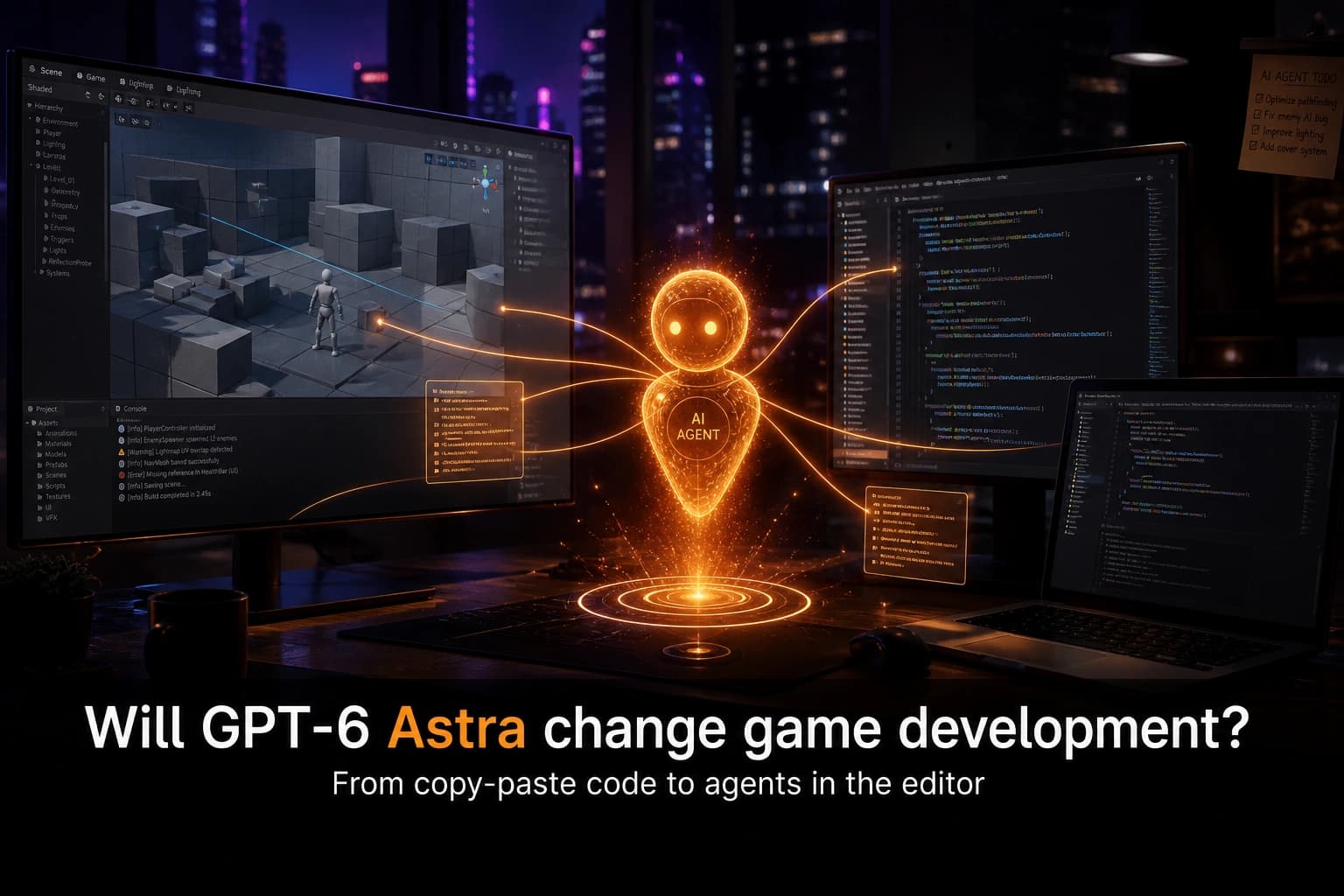
GPT-6 Astra in Unity and Godot: Will it change game development?
GPT-6 Astra for Unity and Godot game development: what Playco built with Playbot, how to use Astra from ChatGPT via MCP, and how it compares to Fable 5.1.
By Tim UhlottFounder|Last updated: September 24, 2026|26 minutes read
game developmentaiopenai
OpenAI released GPT-6 Astra (opens in a new tab), a brand new model for ChatGPT and the API. They promise a near-AGI-ready model, and the release interestingly focuses on game development in Unity and Godot. Game studio Playco even built Playbot, an AI game development IDE, on top of it.You might already have seen videos of GPT-6 Astra-built games in Unity or Godot on X (Twitter) or other social platforms. The demos look really great, but does it really change game development forever? And will it change the industry?In this article, we will explore the release, the numbers, and the reality of GPT-6 Astra in game development. You will learn whether you can use Astra in Unity or Godot today, how to connect it to the engine, and whether the AGI promise is real.
When GPT-6 Astra released
OpenAI released GPT-6 Astra on September 3, 2026. The official announcement (opens in a new tab) calls it a new generation model for computer use, software engineering, science, and professional work.But not everyone got access on day one.
Who
When they get it
A first wave of approved organizations
September 3, 2026
ChatGPT Plus, Pro, Business, and Enterprise
Rolling out over the following days
OpenAI API (gpt-6-astra) and Amazon Bedrock
Same staged rollout
Free ChatGPT
No public date
Usage inside ChatGPT counts against the usual subscription limits. Extra credits are for sale if you run out. Pro, Business, and Enterprise also get GPT-6 Astra Pro. On Enterprise, Astra starts off. An admin has to turn it on.If you opened ChatGPT on launch day and did not see the model, that is the staged rollout. As of this writing, a few days after launch, paid users are still getting access.Here are the current numbers:
Spec
GPT-6 Astra
Context window
1.05 million tokens
Max output
128,000 tokens
Knowledge cutoff
April 30, 2026
API name
gpt-6-astra
Takeaway: Astra is out. But most ChatGPT and API users still have to wait.
How it compares to GPT-5.6 Sol, Fable 5, and Fable 5.1
OpenAI advertises Astra as the new frontier model, and sure it is really good. But it does not beat Anthropic's Claude Fable on every test.Claude Fable 5 shipped earlier in 2026. Claude Fable 5.1 (opens in a new tab) arrived on September 1, two days before Astra. GPT-5.6 Sol is still OpenAI's previous flagship, and it is much cheaper per token.
Token price
Prices below are vendor list prices per 1 million tokens, short context. OpenAI charges more once a prompt goes past 272,000 input tokens. Sol's $4 / $20 rate is promotional through at least November 21, 2026.
Model
Input
Output
Cache read
Long context surcharge
GPT-5.6 Sol
$4
$20
$0.40
Yes, above 272K input
GPT-6 Astra
$10
$50
$1.00
Yes, above 272K input (2x input, 1.5x output)
Claude Fable 5
$10
$50
$1.00
No extra band like OpenAI's
Claude Fable 5.1
$10
$50
$0.25
No extra band like OpenAI's
Astra Fast mode runs about 2x Standard price for up to 2x speed. Batch and Flex are half of Standard.The list price is easy to compare. For an agent that builds a prototype, it is the wrong number to trust. An agent that finishes in fewer loops can cost less even when each token is more expensive.OpenAI's own Astra page (opens in a new tab) says Astra beats Sol and Fable 5.1 on DeepSWE (a long software-engineering test) at about 57% lower API cost per finished task in the best-performing setup of each model. That is a vendor claim, not an independent lab result. Treat it as a hint, then measure on your own project.
Takeaway: Sol is cheaper per token. Astra and Fable 5.1 cost the same on paper. Fable 5.1 is cheaper when the same big context gets re-read from cache. Astra can still win on total bill if it needs fewer retries.
Astra is stronger when the job is "do the work inside software." Computer use and automation both jump from Sol. So does finishing a loop in the terminal. OpenAI also says Astra finishes computer-use tasks about 47% faster than Sol on OSWorld, and about 1.9x faster than the current Sol Codex setup on Mind2Web.Fable 5.1 is stronger on some independent "how smart is this agent" scores. It leads the Intelligence Index. In independent coding-agent tests, Claude Code still looks slightly ahead. If your workflow is a long reasoning session over a big repo, Fable 5.1 is not the old model.Fable 5 is the older sibling. Same $10 / $50 list price as 5.1. The cache price is worse, and it is a clear step behind 5.1 on Terminal-Bench and AutomationBench.Sol is the budget workhorse. It is close to Astra on DeepSWE. It is far behind on Terminal-Bench 4.0 (37.3% vs 57.9%) and AutomationBench (18.1% vs 41.4%). For "write me a player controller" it is often enough. For "open the editor, change the scene, play, fix, repeat" it is the previous generation.Astra also got better at spatial work and at judging how things look. That is the part game developers will feel. The game studio Playco said the model placed objects in a way that made more sense. It also copied reference images better. Inside Unity, the UI it made responded more cleanly.
Takeaway: Use Sol when tokens are the budget. Use Fable 5.1 when a long coding agent has to think through a big project. Use Astra when the agent has to act inside a tool, see the result, and keep going.
What Playco built with GPT-6 Astra: Playbot for Unity and Godot
Playco (opens in a new tab) started as an instant-gaming studio. The idea was games you can play without installing an app, on platforms like Facebook, LINE, Zoom, Discord, and similar social apps. Titles such as EverWing came from that world.What they built with Astra is Playbot, an AI-powered IDE for professional game developers. Put simply, Playco's Playbot is the tool that lets GPT-6 Astra work directly inside a Unity or Godot project. OpenAI published its Playco case study on launch day: Playco cut manual fixes 50% prototyping games with GPT-6 Astra (opens in a new tab).The important sentence in OpenAI's Playco case study is this: Playbot connects directly to engines such as Unity and Godot, so models can edit scenes, play and test games, check changes, and work in parallel inside the tools developers already use.The experiment they reported:
The team asked Astra to build an unthemed grey box from simple primitives.
They made a few gameplay and art passes on that foundation.
From the same grey box, Astra produced three themed prototypes in one go.
Most of those prototypes worked on the first take. One cyberpunk version needed a performance fix. The others did not need another engineering pass.
Compared with the previous model, Playco reports about 50% fewer manual fixes.
Joao Vieira, Playco's lead product engineer, said the first prototype was already strong. The remaining changes were about their gameplay taste, not about fixing a broken build.They also said Astra was better at placing objects in space, copying reference images, making UI that scales in Unity, and game feel. Because Playbot can let the model play the game, Astra caught bugs and flagged player-experience issues without waiting for a human to notice.Read that 50% figure as a customer story, not a lab benchmark. It still tells you something useful. Playco is paying for Astra and connecting it to Unity and Godot for real prototype work.The stack looks like this:
You: "Make me a small zombie shooter"
        |
        v
GPT-6 Astra (the model)
        |
        v
Playco's tooling layer (Playbot)
        |
        v
Unity or Godot
  - create / edit scene
  - create / edit scripts
  - change objects and components
  - run the game
  - inspect the result
  - fix, then run again
Playco sits in the middle box. OpenAI supplies the model. Unity and Godot stay the engines. The unanswered public question is what that middle box is made of. That is the next section.
Takeaway: Playco developed with Playbot, a new AI native IDE. For the development they used Astra as the model.
How to connect GPT-6 Astra to Unity and Godot: engine tools, MCP, or desktop control
OpenAI's demo video looked like Astra is a new desktop control agent. It can control the mouse and keyboard and the screen. But it is not the only way to integrate Astra into a game development workflow.
1. Native or custom engine tools
This is the Playco-shaped path.The model does not click GameObject > Create Empty. It calls operations the engine already understands:
create a game object
add a component
set a transform
create or open a scene
attach a script
enter Play Mode
read the console
capture a screenshot or a bit of game state
Those calls can be a custom OpenAI connector, a Unity Editor plugin, a Godot editor plugin, or a mix. OpenAI's public Playco write-up does not say the transport is MCP. It only says the model is connected to Unity and Godot and can edit, play, and check the result.This difference matters in Unity. A Unity scene is not just a folder of .cs files. It is saved editor data: GameObjects, prefabs, components, lighting, UI canvases, addressable groups. A model that only edits scripts is not the same as an agent that can change the scene.Godot is easier if you only edit files, because scenes are text (.tscn) and scripts are ordinary files. Even there, being able to run the game, read errors, and tweak nodes through the editor is a different product than a chat that dumps GDScript.
2. MCP (Model Context Protocol)
MCP (opens in a new tab) is one standard way to expose those same operations.Think of MCP as a plug format. ChatGPT, Codex, Cursor, or another host speaks MCP. A Unity or Godot MCP server offers tools. The model then reasons in a loop:"I need a player, so I call create_game_object(), add a character controller, attach a script, run the game, read the console, fix the jump bug, run again."A Unity MCP server might offer tools such as:
This is much more powerful than generating a C# file in chat. It is also not magic. The model can only do what the server exposes, and only with the permissions you gave it.You can already try this path. Community Unity MCP bridges exist, including CoplayDev/unity-mcp (opens in a new tab) and CoderGamester/mcp-unity (opens in a new tab). Unity is also building a more official AI Gateway (opens in a new tab) with a relay, a tool registry, and project-level permissions. Godot has community MCP servers as well.None of those are Playbot. They are the same kind of interface: structured tools into the editor.I already wrote more about the security side of MCP in Is MCP a security concern for game developers?. Short version: tools that can edit your project are powerful, and they expand what a bad prompt or a bad server can touch.
3. Desktop control (computer use)
The third setup is the one people picture from the videos.
GPT-6 Astra
    |
    v
computer-use actions
    |
    v
mouse, keyboard, and screen
    |
    v
the Unity or Godot editor, used like a human
Astra is unusually good at this. That is a big part of why OpenAI is pushing it. In principle it can open the editor, click through menus, type into the Inspector, press Play, and read the Game view.In practice this is the fragile path. UI layouts change. A modal dialog blocks the next click. A pixel-level miss creates the wrong object. A long playtest is expensive, because the model is watching frames instead of calling run_game().Desktop control is a fallback when no engine API exists. It is a poor first choice if you can expose real tools.
4. The game never leaves ChatGPT
There is another demo that looks like "Astra made a game" and has nothing to do with Unity or Godot.ChatGPT can host an interactive widget. Apps SDK or MCP can serve a small React (or similar) game that runs inside the chat:
ChatGPT
  ├── the conversation
  ├── MCP tools
  └── a game widget
         └── the game runs inside ChatGPT
OpenAI also points at Sites in ChatGPT (opens in a new tab), where Astra can create websites, web apps, and games from a prompt, then host and share them. That is fine for a toy or a pitch. It also works for a web mini-game. It is not your Unity player, and it is not your Godot export.
Takeaway: If a video shows GPT building in Unity, do not assume it is driving your desktop. It may have a tool connection into the engine. It may also be a web game that never opened an editor.
What GPT-6 Astra can do in game development today
Here is the honest "today" list, a few days after launch.Possible, if you have access and you build the connection:
Grey-box prototypes from a short brief, then several themes on the same foundation (this is the Playco result).
An agent that edits scenes and scripts, then plays the result, if you give it engine tools (Playbot-style, or MCP, or a custom plugin).
Faster first takes on layout, simple combat loops, menus, and "make this look more like the reference image."
Parallel helpers inside the same project, if your tools allow it. One agent can work on the player while another works on enemies or a UI screen.
Supervision from ChatGPT or Codex: you review diffs, reject a bad scene edit, and steer the next pass.
Small playable games inside ChatGPT, with no engine install.
Community MCP into a local Unity or Godot editor, if you accept the setup work and the security tradeoff.
Possible in principle, but a worse idea:
Letting Astra click through the Unity or Godot UI with computer use, the same way a junior would. It can work for a short demo. It will fight you on a real project.
What from Playco's demo you can copy:The big change is not better C#. It is this loop:
old:  LLM → code → you paste → you press Play → you fix
new:  LLM → agent → engine → observe → test → modify → repeat
The model is no longer only saying "here is a player controller." It is closer to "I will add the controller, put it in the scene, run the game, notice that jumping does not work, inspect the console, change the script, and run again."That is why the Playco demo looks more capable than a chat that only writes a script.
What GPT-6 Astra cannot do in game development yet
A short list, so hype does not set your sprint plan.
You cannot install Playbot as a public Unity or Godot package today. Playbot is Playco's product. OpenAI did not ship a "GPT-6 Astra for Unity" button.
The public story does not prove Playco uses MCP. The connection exists. The protocol is not named. Do not wait for an official "OpenAI MCP for Unity" stamp that may never arrive. You can still build an MCP server yourself.
Astra will not ship your game. Art direction, economy, live ops, platform cert, accessibility, and the last 20% of game feel still need people. Playco's own quote is about taste being the remaining work after the first prototype.
A prompt is not a design document. "Make me a small zombie shooter" can produce a grey box. It will not produce your combat identity. It also will not produce your retention loop or a store page that sells.
File-only agents are not engine agents. In Unity especially, generating .cs files is not the same as editing the scene, prefabs, and serialized components.
Broad access is still rolling out. If your team is not in the first wave, you cannot treat Astra as the default model on Monday morning.
Tokens are not free. A play-and-fix loop can burn a lot of context. Sol is cheaper per token. Fable 5.1 is cheaper on cache. Astra can be cheaper per finished prototype, or it can be a surprise bill if the agent keeps retrying and never gets there.
Safety gates can stop a session. Astra is a more tightly monitored model than Sol. Some long tool sessions may pause for review. That is annoying in a game jam. It is also why OpenAI shipped it this way.
People still sit between the model and the engine. OpenAI's own Unity case study talks about developers who build these workflows, inspect them, and supervise them. They are describing a job that still needs a person.
How GPT-6 Astra changes Unity and Godot development
Astra will not replace Unity or Godot developers. It will change a normal workday, first on prototypes, then on production chores.
GPT-6 Astra for Unity developers
Unity is where engine tools matter most. A lot of a Unity project lives in YAML scenes and prefabs. Inspector values are in there too, and a code model never sees that data.If you only let Astra write scripts, you will get the 2024 experience. You get a decent PlayerController.cs. The scene is still broken, and a reference is missing in the Inspector.If you expose editor operations (native plugin or MCP), Astra can do the parts that used to eat a morning:
spawn a player and a floor, add a camera, then wire the references
add a canvas and a health bar that actually stretches
press Play, notice the character falls through the floor, fix the collider, press Play again
duplicate a grey box into a second theme without you rebuilding the hierarchy by hand
That is a real change for pre-production. Grey boxes get cheaper, and so do theme variants. A solo developer can test more combat ideas in a day.It does not remove the Unity-shaped problems you already know: Addressables, IL2CPP, platform plugins, render pipelines, and "why is this prefab override different in the build." Those still need a person who has shipped a player.If you want to try a local version of the loop, start with a dedicated test project. Use a trusted MCP server or a small Editor tool API. Make a hard rule that the agent cannot touch your main branch. Watch the console. Treat every scene diff like a pull request.
GPT-6 Astra for Godot developers
Godot already stores a lot of the game as text. A strong coding agent (Astra, Fable 5.1, or even Sol) can get further on files alone than it can in Unity.The Playco story still applies. Prettier GDScript is not the win. The win is the agent running the scene. It can see that the character controller feels floaty, then change the node properties until a playtest looks right.Godot's lighter editor and smaller project sizes also make MCP or a custom plugin easier to set up than a giant Unity repo. If you already use version control and read .tscn diffs, watching an agent is closer to reviewing a normal pull request.
What will actually change in studios
In the near term, expect this:
Work
What changes
Grey box and first playable
Much faster, if the engine connection exists
Theme / skin variants of a prototype
The Playco "three from one" pattern becomes normal
Boilerplate systems
Player move, simple AI, menus, debug overlays
Playtest and "does jump work"
Agents can run and report, not only write
Direction and game feel
Still human, including shipping. Maybe more human, because more prototypes exist
Live title work
Unchanged. A faster prototype is not a safer live game, and it does not fix cheats or economy
The job shifts. You spend less time typing the first version. You spend more time defining the outcome and reviewing what the agent did. You also decide which tools the agent is allowed to use.That is a skill. Teams that treat the agent like an unpaid intern with root access will make a mess. Teams that treat it like a junior with a checklist will ship more experiments.So, will GPT-6 Astra change game development?It changes the prototype loop. The model can act inside the editor instead of only generating code. For Unity and Godot, the teams that get there will not be the ones who paste better scripts. They will be the ones who give the model a safe, structured door into the editor. A person still owns taste and systems. They also own everything that happens after the grey box works.The rest of game development (the part players pay for) is still yours.
490490 views
00 shares
Discussion about this post
No comments yet. Be the first to start the discussion.