AI is Making Things Up Leading to New Cybersecurity Risks

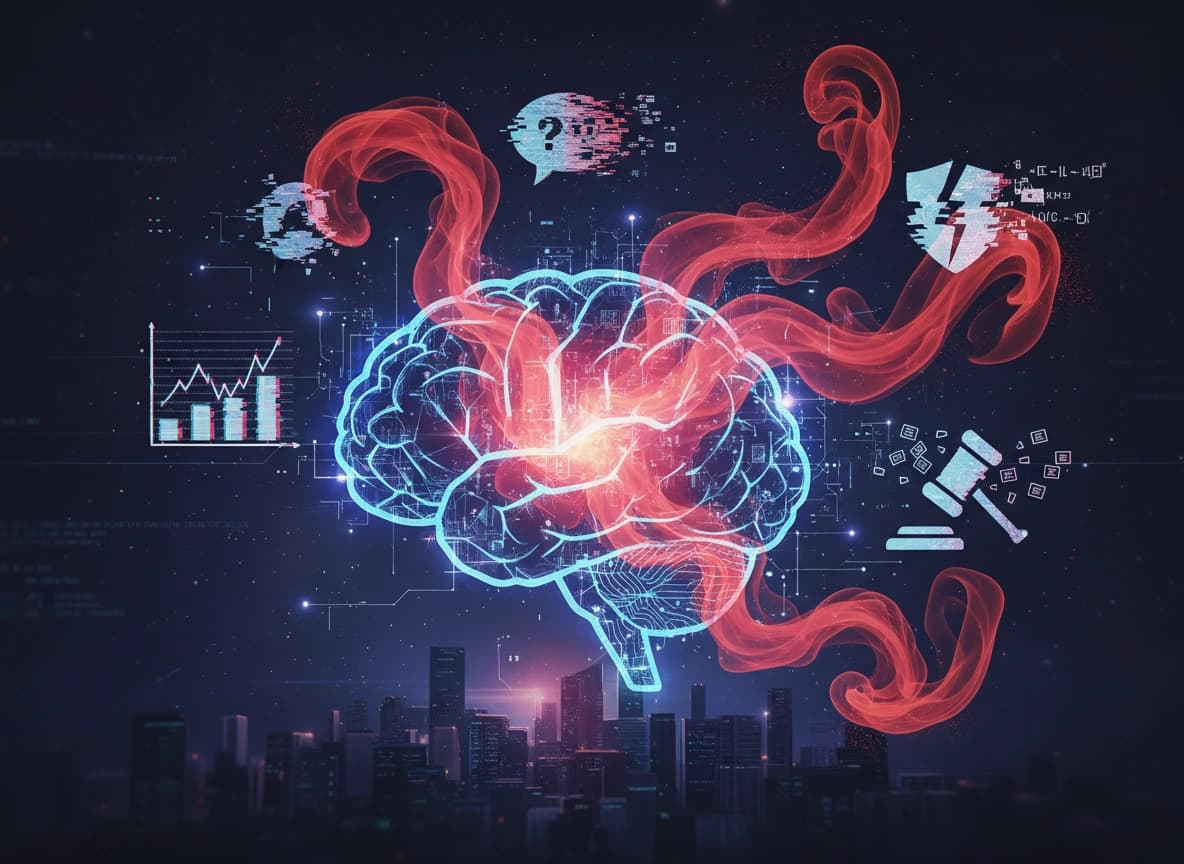
When AI models confidently generate false or misleading information, the results can lead to serious cybersecurity risks.
By Hirum KigothoTeam|Last updated: May 19, 2026|12 minutes read
cybersecurity
AI is Making Things Up Leading to New Cybersecurity Risks
Artificial intelligence is rapidly transforming enterprise operations. Businesses are integrating AI assistants into customer support, software development, cybersecurity operations, financial analysis, legal workflows, and internal productivity tools. However, as organizations rush to adopt large language models (LLMs) and autonomous AI agents, new problems caused by AI hallucinations are arising. In enterprise environments, these hallucinations are not only causing embarrassing mistakes but also serious cybersecurity, compliance, operational, and reputational risks.

What Are AI Hallucinations?

Hallucinations happen when AI models generate outputs that sound convincing but are inaccurate, fabricated, or disconnected from reality. Hallucinations are especially dangerous because AI systems communicate with high confidence. Employees may trust incorrect outputs without verifying them.

Factors that may cause AI to hallucinate

Flawed or outdated training data

AI models learn patterns from massive datasets collected from the internet, books, code repositories, and other digital sources. If that training data contains outdated facts, insecure code, misinformation, or factual errors, the AI can reproduce those inaccuracies in its responses. Because the model does not truly “understand” information the way humans do, it cannot reliably distinguish between correct and incorrect data unless additional safeguards are in place.

Bias in training data

When certain viewpoints, coding patterns, or scenarios are overrepresented in the data, the AI may incorrectly assume those patterns apply universally. This can lead to distorted outputs, inaccurate recommendations, or insecure assumptions.

Ambiguous or poorly written prompts

Unclear instructions can increase hallucination rates. When users provide vague prompts or incomplete context, AI systems often attempt to “fill in the gaps” by making assumptions. This can result in fabricated details, inaccurate summaries, or incorrect technical outputs that appear believable at first glance.

Impacts of Hallucinations in the Enterprise Environment

AI Hallucinations in Customer Support Chatbot

Businesses are increasingly relying on generative AI to handle customer interactions. One of the most common problems occurs when chatbots invent company policies, refund terms, pricing details, or product information that do not actually exist. Customers may receive incorrect instructions regarding account issues, delivery timelines, warranties, or billing disputes. In some cases, AI systems have promised refunds, discounts, or services that companies never intended to offer. Because chatbots often respond with confidence and authority, customers may assume the information is accurate, leading to frustration and disputes when human support teams later contradict the AI-generated responses. An example is when a tribunal ruled against Air Canada after the airline’s AI-powered chatbot provided a customer with misleading information about its fare policy. The tribunal concluded that Air Canada had failed to properly verify the accuracy of the chatbot’s responses and ordered the airline to compensate the passenger. Hallucinations in customer support systems can also create security and privacy risks. An AI chatbot may misunderstand user requests and expose sensitive information, provide incorrect troubleshooting instructions, or direct users toward unsafe actions.

Hallucinated Vulnerabilities and False Threat Intelligence

Security analysts are using AI tools to summarize threat intelligence and assist in incident investigations. These systems can help process large volumes of security data quickly, but they also introduce risks when hallucinations occur. In some cases, AI models may generate false indicators of compromise (IOCs), invent nonexistent malware families, or fabricate vulnerability identifiers such as CVEs. These inaccuracies can create serious operational challenges for security teams. Analysts may waste valuable time investigating threats that do not actually exist, while real attacks may be overlooked due to confusion or misdirection. In addition, automated security systems that depend on AI-generated outputs may trigger unnecessary responses, such as blocking legitimate traffic or escalating non-critical alerts.

Hallucinations in Software Development

Security researchers have warned that developers often place too much trust in AI-generated code without conducting thorough reviews or security checks. As a result, hallucinated or flawed outputs can make their way into production systems, increasing the risk of security breaches and operational issues in enterprise environments. Researchers have shown that AI coding assistants can hallucinate software packages or insecure code suggestions. Developers relying on these outputs may accidentally install malicious packages created by attackers using names similar to the hallucinated ones. This emerging attack technique is called “slopsquatting.” AI systems may reference court decisions, statutes, or legal precedents that do not exist, yet present them in a highly convincing format. If lawyers fail to verify these outputs, such errors can make their way into court filings or legal arguments, potentially damaging a case and exposing practitioners to professional sanctions or disciplinary action. A U.S. attorney used ChatGPT to assist in preparing court filings, but unknowingly included completely fabricated legal cases generated by the system. When the opposing counsel questioned the validity of the citations, the lawyer stated that they did not understand that ChatGPT was a generative language model rather than a verified legal research database. In response, a federal judge issued a standing order requiring all parties appearing before the court to confirm whether AI tools were used in drafting submissions, and to clearly identify any AI-generated content so it can be independently reviewed for accuracy. Hallucinations can also affect contract drafting and compliance work. AI tools may misstate regulatory requirements, overlook jurisdictional differences, or invent clauses that do not align with actual law. In high-stakes environments such as mergers and acquisitions, employment law, or data privacy compliance, even small inaccuracies can lead to contractual disputes, regulatory violations, or financial losses.

AI Hallucinations in Medical Workflows

Healthcare systems are adopting generative AI for clinical support, documentation, and decision assistance. These tools are being used to summarize patient records, suggest possible diagnoses, draft clinical notes, and assist with treatment planning. While they can reduce administrative burden and improve efficiency, hallucinated outputs can introduce incorrect or misleading medical information at critical points in care. One of the most significant risks is the generation of false or unsupported clinical recommendations. An AI system may confidently suggest a diagnosis that does not match the patient’s symptoms or invent treatment options that are not medically appropriate. In a clinical environment, such errors can lead to delayed treatment, incorrect prescriptions, or unnecessary procedures if not carefully reviewed by qualified medical professionals. OpenAI Whisper, a speech-to-text system used in healthcare settings, has been reported to produce hallucinations in its transcriptions. An investigation by the Associated Press found that the model sometimes generates fabricated content, adding words or even full phrases that were never spoken in the original audio. These errors have included incorrect attributions such as race, violent statements, and entirely nonexistent medical treatments. Although OpenAI has cautioned against using Whisper in high-risk environments, reports indicate that more than 30,000 healthcare professionals are still relying on Whisper-based tools to transcribe patient consultations.

AI Hallucinations in business and financial reports

Organizations are using AI tools to produce financial summaries, investor updates, market analyses, and internal reporting documents. These systems are often used to speed up reporting cycles, reduce manual workload, and extract insights from large volumes of data. However, when AI models hallucinate, they can generate inaccurate figures, fabricate supporting explanations, or misrepresent financial performance in ways that appear credible but are factually incorrect. In financial reporting, even small errors can have major consequences. A hallucinated revenue figure, incorrect growth rate, or invented explanation for market performance can mislead executives, investors, and stakeholders. If such inaccuracies make their way into official reports or earnings summaries, they can distort decision-making and violate accounting standards or regulatory requirements. This becomes dangerous in publicly traded companies, where financial disclosures are closely scrutinized by regulators and markets. An example is when a report prepared by Deloitte for the Australian government was later found to include several fabricated citations and nonexistent footnotes. Following these findings, Deloitte agreed to refund part of a government contract valued at approximately $300,000. The issues came to light after a University of Sydney academic identified multiple inaccuracies in the report and called for an investigation. In response, Deloitte acknowledged that it had used a generative AI tool to address “traceability and documentation gaps” in its analysis. In another case, Google faced criticism after its AI chatbot Bard provided inaccurate information during a public demonstration. The chatbot incorrectly claimed that the James Webb Space Telescope had captured the first images of an exoplanet, even though that achievement had occurred earlier with another telescope.

Reducing the Risks of AI Hallucinations

Human-in-the-Loop Oversight

Human-in-the-Loop Oversight is an approach where human judgment is kept in the decision-making process of AI systems, especially in situations where errors could have serious consequences. Instead of allowing AI to operate fully autonomously, organizations require human review and approval before key actions are taken. This helps ensure that AI-generated outputs are evaluated for accuracy, context, and potential risk before being applied in real-world environments.

Retrieval-Augmented Generation (RAG)

RAG is an AI technique that connects LLMs to external, authoritative data sources. Instead of relying solely on patterns learned during training, RAG-based systems first search trusted data sources, such as internal company documents, databases, or verified knowledge repositories, and then use that retrieved information to generate responses. This reduces hallucination rates by limiting AI outputs to trusted enterprise knowledge bases.

Apply least-privilege controls to AI systems

Organizations should limit AI systems to only the permissions necessary for their specific functions. For example, an AI assistant may be permitted to read files or analyze data, but not modify or delete sensitive information. This helps contain damage if the AI produces hallucinated recommendations or incorrect instructions.

Train employees in effective prompt engineering

The quality and accuracy of AI-generated responses are heavily influenced by the prompts users provide. Prompt engineering is the practice of designing and refining instructions to optimize the performance of generative AI models. Organizations should invest in prompt engineering training so employees can create clear and specific instructions that guide AI systems toward more reliable and verifiable responses. Equally important, employees should be trained to independently verify outputs before acting on them, particularly in high-risk areas.

Use multiple AI models for verification

Depending entirely on a single AI model can create a single point of failure, especially when hallucinations or inaccurate outputs occur. Organizations can reduce this risk by using multiple AI models in parallel and comparing their responses for consistency and accuracy. Cross-checking outputs helps identify conflicting information, detect hallucinations, and improve confidence in the final result. This functions similarly to consulting multiple experts rather than relying on one source alone, strengthening both reliability and decision-making accuracy.

Conclusion

As AI systems become more autonomous and integrated into business operations, the consequences of incorrect outputs grow more severe. Organizations must implement AI responsibly, maintain strong governance, and recognize that even the most advanced AI systems can still generate dangerously incorrect information.

Share this article

Frequently asked questions

More on this topic

Newsletter

Stay in the Loop.

Subscribe to our newsletter to receive the latest news, updates, and special offers directly in your inbox. Don't miss out!