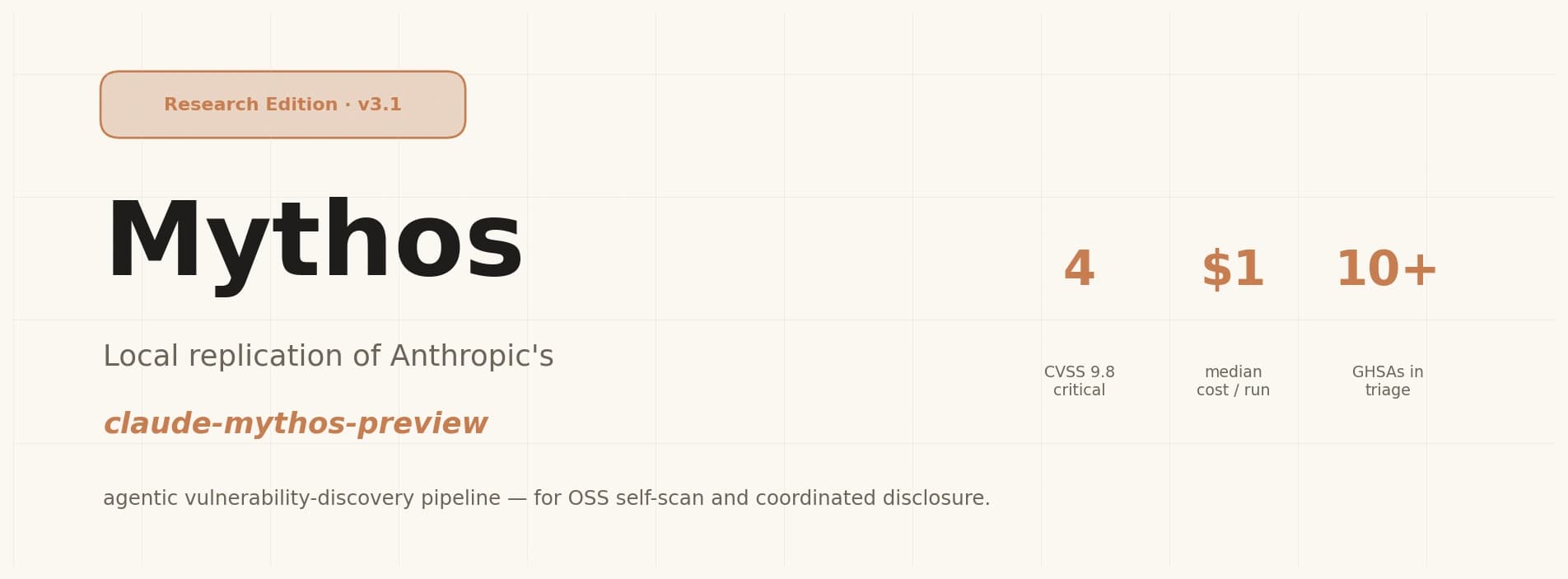
Learn to recreate the Mythos pipeline locally and run your own security researcher with Claude Code.
By Tim UhlottFounder|Last updated: April 30, 2026|10 minutes read
aiclaude codeclaude
Claude Mythos refers to a frontier-class agentic security system introduced by Anthropic in early 2026, designed to autonomously discover and exploit software vulnerabilities at scale.The system became widely discussed because of its reported ability to produce fully working remote code execution exploits from real-world codebases with minimal human guidance. In one described case, an engineer with no security background prompted the system overnight and woke up to a complete exploit chain.Claude Mythos preview is reported to achieve:
93.9% on SWE-bench Verified
97.6% on USAMO-level math benchmarks
83.1% on CyberGym security tasks
More importantly, it has been described as capable of discovering zero-day vulnerabilities across major operating systems and browsers, which led to Anthropic restricting public access and instead launching Project Glasswing for controlled deployment to selected infrastructure partners.This makes Mythos less of a typical model release and more of a controlled security capability.
Why Mythos feels like a shift in security research
Mythos represents a structural shift in how vulnerability research is performed.Traditional security workflows rely on:
static analyzers
fuzzing systems
manual code inspection
exploit chaining by human experts
Mythos replaces much of this with an agentic loop that:
prioritizes risky code regions
reasons about data flow and input surfaces
generates vulnerability hypotheses
validates findings through tooling and secondary review
Instead of replacing security tools, it orchestrates them through an LLM-driven workflow.
What Mythos actually does under the hood
At a high level, Mythos operates through a structured multi-stage pipeline:
A codebase is loaded into an isolated environment
The system scans for high-risk file regions
The model ranks files by vulnerability likelihood
Focused analysis is performed on selected files
A secondary agent validates findings
Results are aggregated into structured reports
File risk is typically categorized as:
constants, no meaningful risk
internal utilities
business logic
input handling, databases, authentication
network-facing or cryptographic components
The key design principle is prioritization: not all code is equally important.
How to recreate the Mythos pipeline
The open-source research scaffold at
https://github.com/Keyvanhardani/Mythos-research (opens in a new tab)
implements a local, reproducible version of this workflow using general-purpose models like Claude Opus through the Claude Code CLI.Created by Keyvan Hardani — Applied AI Researcher and Engineer, the system focuses on structured vulnerability discovery rather than exploitation.The pipeline is divided into seven parameterised phases. Phases 0–4 and 6 are open in this edition. Phase 5 (live execution validation) is intentionally excluded for safety and research scope reasons.
Phase 0: Language detection
The system identifies the dominant programming language in the target repository. This determines which vulnerability semantics prompt is used, such as language-specific rules for unsafe memory handling, injection patterns, or deserialization risks.
Phase 1: Sink-guided slicing
A curated sink catalog (e.g. scripts/lib/sinks/*.txt) is executed over the codebase using fast search tooling. This produces structured NDJSON entries like:
category
pattern
file
line
code snippet
This step dramatically reduces search space before any reasoning begins.
Phase 2: File ranking
Files are scored based on sink density and risk category distribution. High-signal categories dominate ranking:
deserialization issues
code evaluation (eval-like sinks)
SQL injection surfaces
prototype pollution
XXE vulnerabilities
unsafe framework patterns
input sanitisation gaps
browser API misuse
Files containing only safe variants (e.g. SAFE_* patterns) are deprioritised.
Phase 3: Agentic hunt
A separate Claude Code subagent is launched per high-ranked file. Each agent receives:
sink context for that file
vulnerability semantics prompt (VSP)
optional diversity hint for exploration variation
These agents independently search for vulnerabilities in parallel.
Phase 4: Skeptical validation
Each candidate finding is re-evaluated by a second-pass agent acting as a skeptical reviewer. It reassesses:
correctness of the vulnerability
exploitability
false positive likelihood
Output labels include:
CONFIRMED
FALSE_POSITIVE
DOWNGRADED
NEEDS_MORE_INFO
Phase 5: Live execution (excluded in this repo)
This stage performs runtime validation of exploits in a controlled execution environment. It is intentionally omitted from the public repository to avoid turning the scaffold into an automated exploitation system.
Phase 6: Aggregation
All results are compiled into structured JSON reports containing:
severity breakdown
per-phase telemetry (cost, runtime, hits)
validation outcomes per finding
deduplicated vulnerability summaries
Running your own Mythos locally with Claude Opus
Once dependencies and Claude Code CLI are installed:
# 1) clonegit clone https://github.com/Keyvanhardani/mythos-research.git
cd mythos-research
# 2) make sure Claude Code CLI is availableclaude --version# 3) run against a target directory (read-only)bash scripts/mythos-v3.sh /path/to/target --max-files 8--budget3.00# optional: diverse sampling (K independent hunters per file)bash scripts/mythos-v3.sh /path/to/target --pass-at-k 3# optional: skip everything that would need exec-validator.shbash scripts/mythos-v3.sh /path/to/target --skip-exec
Optional flags:
--pass-at-k 3 → multiple independent analysis runs per file
Inside the created reports and logs directories you will the findings. For example for the class app/Services/AstronautTrainingService.cs it looks like:
{"findings":[{"severity":"LOW","title":"Non-critical logging verbosity in training initialization","location":"L118 initializeTrainingSession()","description":"Training session initialization logs full simulation metadata (astronaut role, scenario ID, and environment preset) at INFO level. While no sensitive data or secrets are present, the verbosity may slightly increase log noise in high-throughput simulation runs."}],"verdict":"PASS_WITH_MINOR_ISSUE","notes":"All execution paths in AstronautTrainingService.cs operate on internally generated simulation data with no user-controlled or external inputs. Scenario configuration and telemetry streams are strictly sandboxed and deterministic. No injection points, unsafe deserialization, or privilege boundary crossings were identified. The only issue is a low-severity logging verbosity concern that does not impact security posture."}
What you can realistically expect (and what you cannot)
Capability
Performance in Mythos-style systems
Crash-level bugs
strong
Input validation issues
strong
Logic vulnerabilities
moderate to strong
Full exploit chains
limited
Multi-step memory corruption exploitation
weak
The system is strongest at discovery and classification, not full exploit engineering.
Why this matters for game developers
For game developers, this approach is especially relevant in:
It is particularly useful as a pre-release security layer that sits before manual penetration testing.
Conclusion: From tools to structured reasoning systems
Claude Mythos demonstrates a broader shift in software security: The value is no longer in isolated tools or prompts, but in structured reasoning pipelines.The Mythos Research repository shows that even without proprietary internal models, a large part of this capability can be reproduced through:
decomposition of tasks
sink-driven prioritization
multi-agent orchestration
skeptical validation loops
In practice, it turns a general-purpose language model into a coordinated security research system, one that developers can now experiment with directly.
875875 views
00 shares
Discussion about this post
No comments yet. Be the first to start the discussion.